Episode 001: The Stolen Photograph
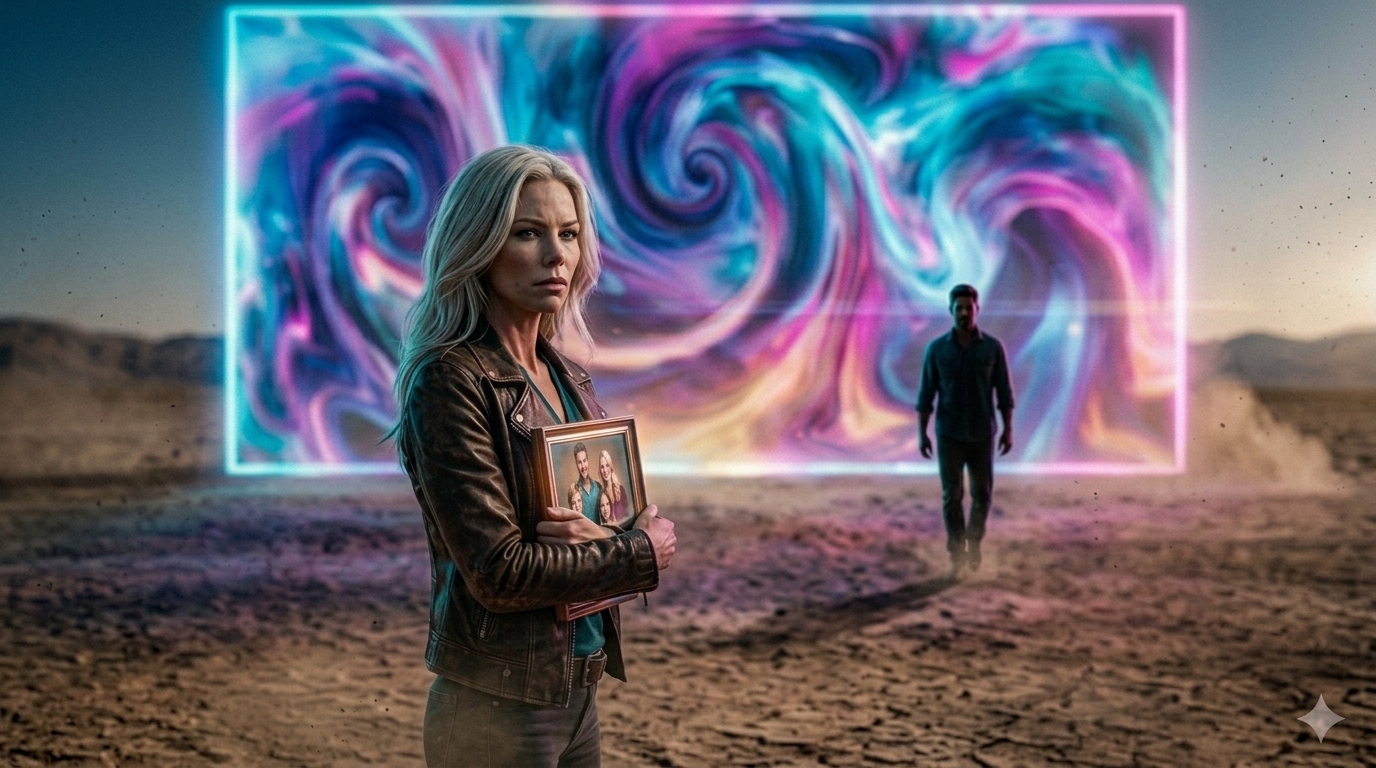
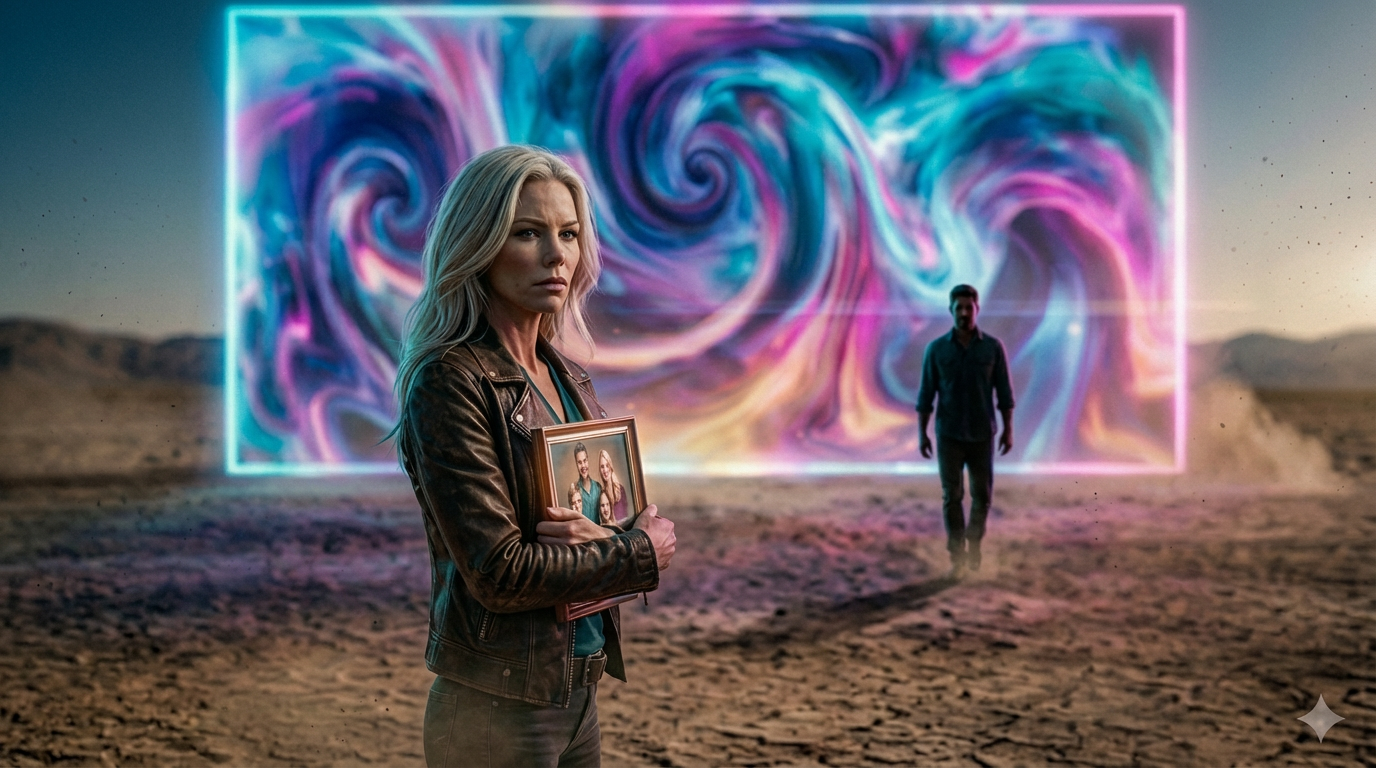
Imagine you break into someone's house. Not to steal anything valuable. Not jewellery, not cash, not electronics. You break in because a man you barely know is stranded in another dimension, and his family has vanished, and the only thing you can think to do — the only gesture that makes any sense at all — is to take a framed photograph off his sideboard and carry it across the boundary between worlds. A family portrait. Mum, dad, two kids. The glass is cool against your ribs where you've tucked it inside your jacket. You can feel the edges of the frame pressing into you the whole way through the Portal — that kaleidoscope of impossible light — and when you step out the other side into the dust and silence of Clivilius, you're holding stolen property. Technically. Legally. Unambiguously. But the man's face when you hand it to him. That's the moment I want to talk about today.
Welcome to the Clivilius Storiverse Podcast. I'm Nathan. And this is where I pull back the curtain on individual moments within Clivilius — the people, the decisions, the collisions between ordinary lives and extraordinary circumstances. Each episode, I take one moment, and I unpack what's really going on beneath the surface. The psychology. The relationships. The things people do when the rules they've lived by suddenly stop applying.
Today: a woman called Beatrix Cramer, a stolen photograph, and a man who doesn't know his marriage is already over.
THE WOMAN WITH THE PHOTOGRAPH.
Beatrix Cramer is thirty-three years old, Tasmanian, and — depending on your perspective — either deeply principled or completely incapable of following the rules. Probably both. She grew up in Claremont, a suburb of Hobart, and from a very young age she had this thing about hidden objects. Not in a creepy way. More like … she was drawn to things that had stories attached to them. The trinket at the back of the drawer. The box no one had opened in years. She'd find them, hold them, turn them over in her hands like she could read the history through touch.
That instinct eventually turned into a career. She ran an antique shop called Timeless Treasures with her partner Brody Taylor. And I should tell you now, because it matters — Brody was murdered in 2014. The shop collapsed. Beatrix's world collapsed. For years after that, she was a person held together by stubbornness and not much else.
By 2018, she'd been arrested. I won't go into the details of that today — that's its own episode — but what matters is that Beatrix ended up in Clivilius. Not as a tourist. Not as an explorer. As someone who'd run out of road on Earth and found, impossibly, that there was somewhere else to go.
And here's the thing about Beatrix that you need to understand before any of the rest of this makes sense: she is allergic to sincerity. Not because she doesn't feel things — she feels things enormously — but because she's built an entire personality around deflecting genuine emotion with dry humour and sharp edges. The more something matters to her, the more likely she is to make a joke about it. It's armour. Very effective armour. And it's the lens through which this entire moment plays out.
THE MAN ON THE OTHER SIDE.
Paul Smith is the other half of this equation. Born in Adelaide, raised in a family that fractured when he was nine, Paul is one of those people who builds. Builds businesses, builds families, builds stability — because stability was the thing he didn't have as a kid, and he's spent his adult life trying to engineer it into existence.
He ended up in Broken Hill, married his high school sweetheart Claire, had two children — Mack and Rose — and ran a business. On the surface, it worked. Underneath, the marriage had been cracking for years. But Paul is an optimist. Relentlessly, almost pathologically. He held on. For the kids. For the idea of the thing, if not the thing itself.
Then his brother Luke called. And nothing was ever the same again.
Paul crossed into Clivilius in July 2018. And very quickly, everything he'd built on Earth began to disintegrate. Claire took the kids. Drove to Brisbane, probably overnight. The house in Broken Hill sat empty — curtains drawn, beds unmade, wardrobes half-stripped. The kind of emptiness that doesn't just mean someone left. It means someone left in a way that wasn't coming back.
And then the police took Charlie. The family dog.
So here's Paul, stranded in a desert dimension, separated from his children, watching his marriage evaporate from a distance he can't close. And along comes Beatrix, carrying a photograph.
THE MOMENT.
Beatrix has just stepped back through the Portal. She's been to Paul's house. She's walked through the rooms, seen the evidence of sudden departure — the scattered shoes, the half-finished drawings, the silence that feels almost hostile. And she's taken one thing: a framed family photograph from the sideboard. Mum, dad, two kids, smiling. The kind of photo every family has. The kind nobody thinks about until it's the only thing left.
She steps through into Clivilius and she just … stands there. Boots in the grit. Frame against her ribs. Caught between two impulses: the urge to go back and put it where it belongs, and the knowledge that it's already too late. She's crossed a line. Taken something from a house that isn't hers, from a life she can't untangle, and carried it across dimensions.
And then Paul appears. Striding towards her. His face cracked open with relief — not about the photo, because he doesn't know about it yet. Just relief that she's back. That she's real. That someone came back.
She tells him what she found. The empty house. Claire and the kids gone. The neighbour reckons the police took Charlie. Paul absorbs each piece like a body blow — flinching, steadying, flinching again. But his eyes never leave hers. Searching. Relentless. As though she might still be holding something back.
And then Beatrix reaches into her jacket and pulls out the photograph.
Paul takes it with a gentleness that feels completely out of character for a man standing in a wasteland. Like the frame might splinter if he grips too hard. His thumb traces across the glass in a slow line, moving over their faces. Claire. Mack. Rose. His lips part, but nothing comes out.
And the silence that follows isn't empty. It's the opposite. It's full. Loaded. The kind of silence that wedges itself between two people and refuses to move until somebody acknowledges it.
THE ART OF DEFLECTION.
Now, here's where Beatrix does what Beatrix always does. She breaks the moment with humour.
Her words, from her own account: "Thought it might brighten the place up. Everyone needs a bit of tatty décor."
And that tells you everything about who she is. She's just performed an act of genuine compassion — broken into a house, stolen a family portrait, carried it between dimensions — and the moment it lands, the moment it actually means something to another human being, she retreats behind sarcasm. "Tatty décor." As though she'd picked up a charity shop painting on a whim.
What's striking about Beatrix's account of this moment is that she doesn't see herself as being kind. She doesn't see herself as being brave. In her telling, she's being practical. Impulsive. Couldn't leave it behind, that's all. Don't read too much into it. But from Paul's perspective — from the outside — what she's done is extraordinary. She's risked something real to bring him a piece of his family.
And the gap between how she sees it and how he sees it — that's where the entire emotional charge of this moment lives. She's standing in the blast radius of her own kindness, trying desperately to pretend the explosion didn't happen.
WHAT PAUL ADMITS.
There's another layer to this that's worth unpacking, and it's Paul's quiet confession about his marriage.
He tells Beatrix — standing there in the dust, clutching this photograph — that he doubts Claire is coming back. That the marriage had been cracking for years. That they held on for the kids, the way people always say they do, but cracks don't close. They spread.
And he says something that I think is quietly devastating: "Claire never needed space. She needed stability. And I couldn't give her that."
Think about what it costs a man like Paul to admit that. Paul, who has spent his entire adult life trying to build stable things. Businesses, families, routines. Stability is his religion. And here he is, admitting that the one person who needed it most from him didn't get it. Not because he didn't try, but because trying and succeeding aren't the same thing.
He's not crushed by it, though. That's the thing. He's already rehearsed this inevitability so many times that it's lost its power to shock him. The grief isn't fresh — it's archaeological. It's been there for years, compacting under layers of optimism and determination, and now that the surface has cracked open, what's underneath is exhaustion more than anything. The tiredness of a man who knew and chose not to know.
And Beatrix just … lets it breathe. She doesn't comfort him. She doesn't fix it. She just stands there and lets the truth sit in the air between them, which is — for Beatrix — about the most generous thing she's capable of.
AND THEN THERE'S THE DOG.
So by the end of this conversation, Beatrix has committed to going back. Multiple times. She'll raid the house. Bring clothes, books, the kids' things. Ordinary objects transformed into lifelines by the sheer absurdity of the situation.
But there's one absence that sits heavier than all the rest. Charlie. The family dog. According to the neighbour — a woman named Gertrude, who is a piece of work in her own right — the police took her.
Now, smuggling jumpers across dimensions is one thing. Breaking a dog out of police custody is something else entirely. And yet the thought doesn't fill Beatrix with dread. It fills her with purpose. Because Beatrix Cramer has always functioned best when she has a task. A direction. Something concrete to grip while the rest of the world tilts sideways.
She doesn't know yet how she's going to do it. She doesn't even know where Charlie is being held. But by the end of this moment, the mission has crystallised. Not the jumpers, not the books, not the chipped mugs. Charlie. Charlie is what matters. Charlie is the retrieval that will mean something.
And that's so completely, perfectly Beatrix. Ask her to sit with an emotional truth and she'll crack a joke. Ask her to break a dog out of a police station across dimensional lines and she'll start planning immediately.
WHAT THIS TELLS US.
What gets me about this moment is how small it is. A photograph changes hands in the desert. That's it. No one fires a weapon. No one makes a speech. No civilisation rises or falls. A woman gives a man a picture of his family, and for a few seconds, neither of them knows what to say.
But everything is in there. Loss. Loyalty. The slow, quiet death of a marriage confessed to a near-stranger. The stubbornness of hope in a man who's been given every reason to abandon it. And a woman whose compassion is so tangled up in self-defence that she can't perform an act of kindness without immediately undercutting it with a joke.
These are real people making real decisions under impossible pressure. And the decisions that matter most — the ones that actually change things — aren't the grand gestures. They're the small, ordinary, morally complicated ones. Taking a photo. Admitting a truth. Deciding to go back.
Somewhere in Clivilius right now, Paul Smith still has that photograph. And somewhere between here and there, Beatrix Cramer is probably planning something she shouldn't be.
AND FINALLY.
Next time on the Clivilius Storiverse Podcast, we step into a different life, a different moment, a different corner of this world. That's how this works — every episode is a window into a single moment and the ripples it sends through the lives around it.
I'm Nathan. Thanks for listening. And if a photograph can travel between dimensions, maybe a story can too.