Episode 003: Dust Trails
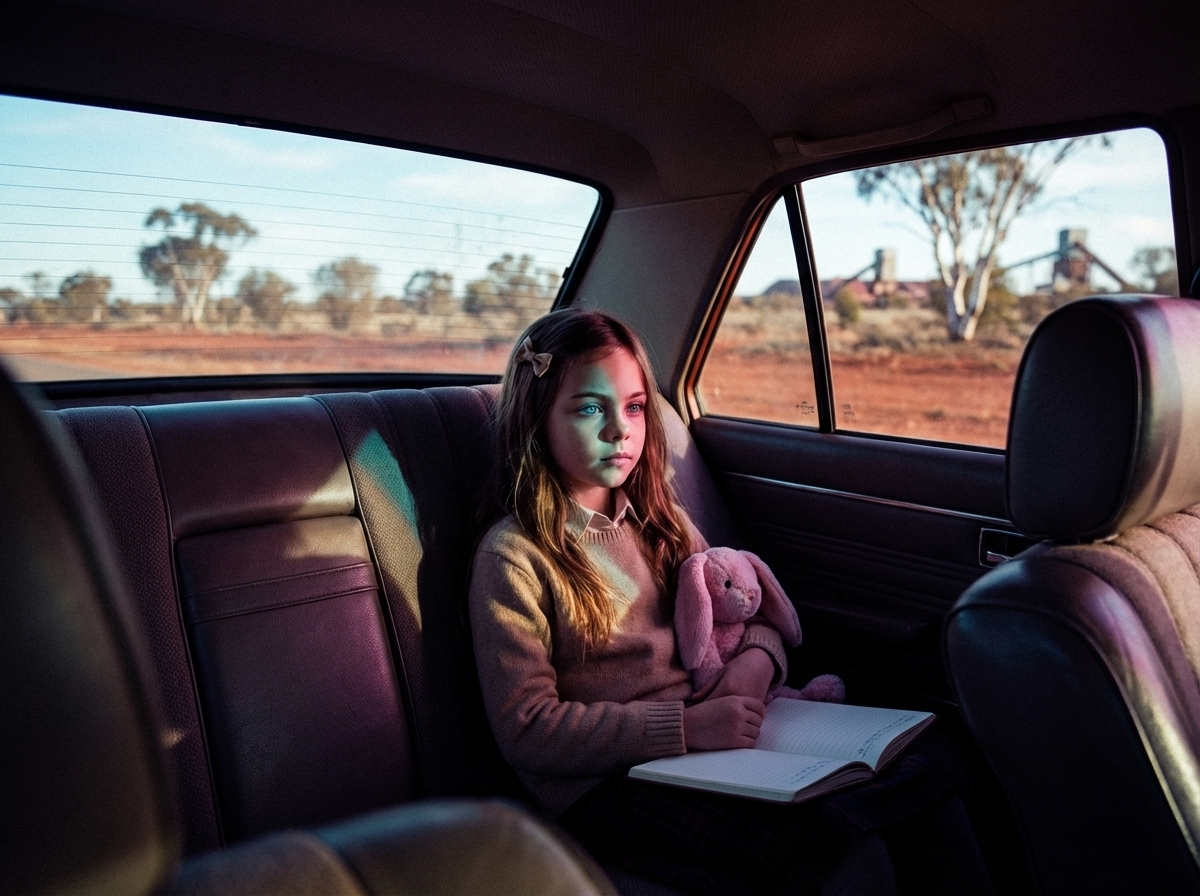
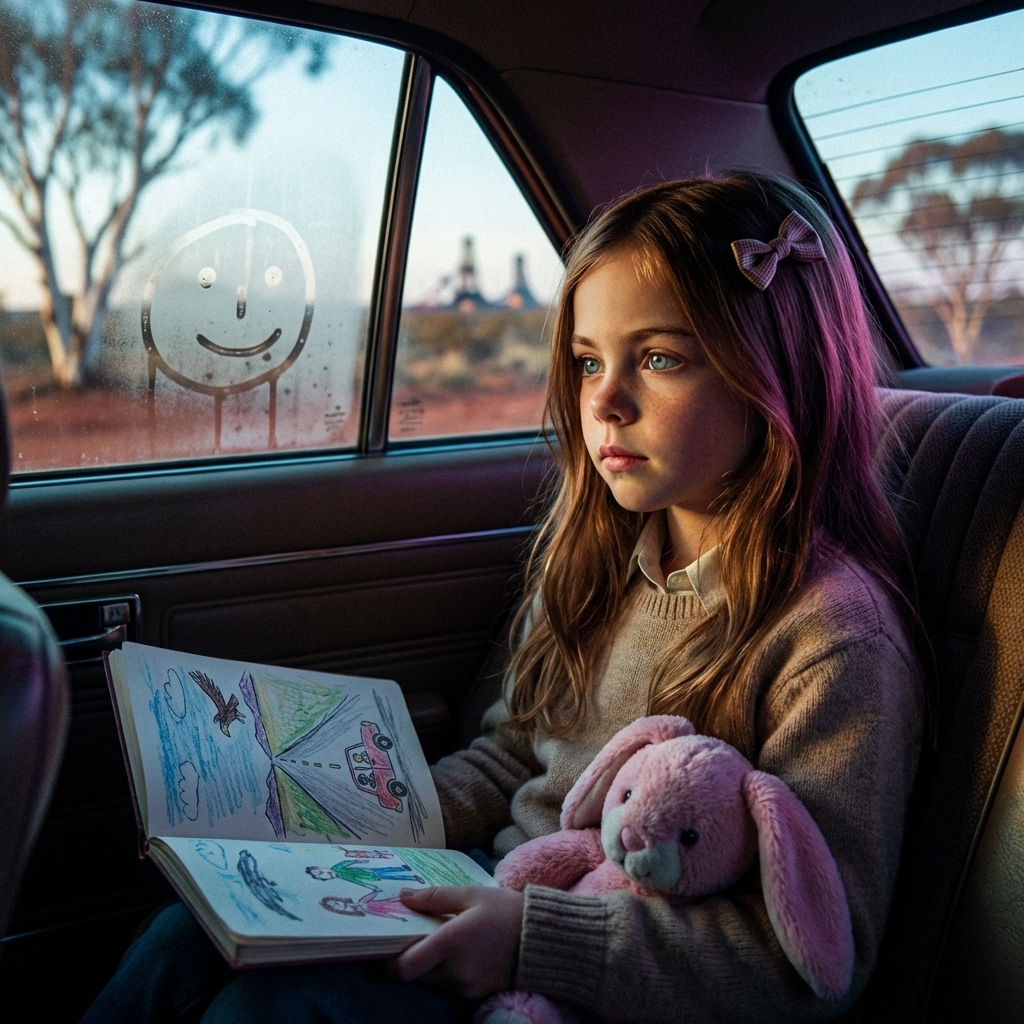
A six-year-old girl is drawing in the back seat of a car. She's drawn a road — long and straight, stretching to a vanishing point that falls off the edge of the page. She's drawn a sky, big and empty. A wedge-tailed eagle with its wings spread wide. And then two stick figures in the back of a wobbly car: herself, with a bow in her hair, and her brother, arms crossed grumpily over his chest, with too many freckles. Her stuffed toy is tucked under her arm, half-flattened from too much hugging. The sausage roll wrapper is scrunched in the door pocket. Her breath keeps fogging the window, and she keeps drawing faces in the condensation — two eyes, a round mouth — that smile sadly for a moment and then vanish. Nobody has spoken in a long time. Her name is Rose. She's six years old. And she has twenty-four days left.
Welcome to the Clivilius Storiverse Podcast. I'm Nathan. And this is where I pull back the curtain on individual moments within the Storiverse — the people, the decisions, the collisions between ordinary lives and extraordinary circumstances. Each episode, I take one moment, and I unpack what's really going on beneath the surface. The psychology. The relationships. The things people do when the rules they've lived by suddenly stop applying.
Today: a back seat, a notebook, and a family driving away from something they can't outrun.
THE GIRL IN THE BACK SEAT.
Rose Abigail Smith was born on the 12th of February, 2012. She arrived in the world laughing, according to the people who were there, and by all accounts she never really stopped.
She loved animals — not in the vague way that most children love animals, but with a specific, worried tenderness. The kind of child who fretted about injured insects. Who would stop walking to check on a bird that looked unwell. Who understood, instinctively, that small things need protecting.
She was fiercely close to her older brother Mack. He was eight — two years ahead of her in age, a lifetime ahead of her in the particular brand of cynicism that eight-year-old boys cultivate like a hobby. But Rose had a way of cutting through it. She watched people with eyes that understood far more than anyone realised. Adults especially. She watched her parents with an attention that was almost unsettling in its clarity.
And right now, on July 28th, 2018, Rose is in the back seat of a car heading east on the Silver City Highway, and she knows that something is very, very wrong. She doesn't have the vocabulary for it yet. She can't name what happened at the building in Broken Hill — the empty-eyed man, the door that shouldn't exist, the way reality seemed to fold in on itself like wet paper. But she knows it happened. She knows it changed things. And she knows that Mum isn't driving towards something. She's driving away.
LEAVING WITHOUT FAREWELL.
The family left Broken Hill that morning without going home. Without checking on Grandma. Without saying goodbye.
I want you to sit with that for a second. Because Rose does. She notices it. She notices everything.
Claire — Rose's mum — came back from the service station, handed Mack some bottles of water, handed Rose a warm sausage roll in a brown paper bag, the grease already soaking through in spots. And then, without ceremony: "All right. Let's go."
No "buckle up." No "one last look." No "we'll be back."
Just the engine turning over with a reluctant cough — Rose describes it as though even the car didn't want to start — and then they were moving. Gravel crunching beneath the tyres. The mining town shrinking in the rear-view mirror. The headframes standing rigid against the sky like sentinels watching them leave with blank, industrial indifference.
And Rose twisted in her seat and looked back. She watched Broken Hill disappear — first rooftops, then fences, then chimney lines. Then nothing. Just earth and sky and a road stretching out behind them, fading into a kind of distance that she describes as feeling bigger than it should.
The last thing she saw was a flock of galahs bursting out of some ghost gums. Pink underbellies flashing. One wheeling turn in the pale blue sky, and then they scattered.
Gone.
THE SILENCE.
What follows in Rose's account is one of the most extraordinary passages in the Storiverse, and it's extraordinary precisely because nothing happens.
They drive. The Silver City Highway stretches ahead in a long, unbroken strip of bitumen. The sun is low and cold — that winter trick of light without warmth. Mulga trees cast shadows like crooked fingers. Spinifex catches frost on its tips. And inside the car, nobody speaks.
Rose describes each member of her family in this silence with devastating precision. Mack sits beside her, forehead pressed against the window, fogging the glass in slow rhythmic clouds. His hand rests on a dead phone — Grandma's old one — his fingers curled around it with pale knuckles, as though believing if he holds on long enough it might spark to life.
Claire drives with both hands gripping the wheel like it might try to turn itself. Knuckles white and sharp. She keeps glancing in the rear-view mirror — not at the children, Rose notices, but at the road behind. Checking. Watching. For what, Rose doesn't know. Every so often Claire reaches for her own phone. Checks the screen. No messages. No calls. Her lips press thinner each time.
And Rose? Rose leans her head against the window, the cool of the glass sinking into her skin, and tries not to think about what happened. The building. The girl. The empty-eyed man who stepped through the world like it was made of paper.
She can't manage it, of course. Six-year-olds don't have the machinery for suppression. They don't know how to build the compartments that adults use to store things they'd rather not examine. So instead of not thinking about it, Rose does what Rose always does.
She opens her notebook.
THE NOTEBOOK.
This is the detail that breaks me, every time I come back to this moment.
Rose opens her notebook — the cover gone soft at the corners from handling — and flips past earlier drawings. The kitchen at Grandma's house, with the too-loud clock stuck at ten past three. Grandpa's chair, the sag in the cushion still visible even in crayon. She doesn't want to look at those. Not now. Not with Grandpa sick and Grandma not answering the phone.
So she starts a new page.
She draws the road. Long and straight, stretching to a vanishing point that falls off the edge of the page. A sky — big, empty, impossible. A wedge-tailed eagle gliding on invisible air. And then the car, with two stick figures in the back: herself with a bow in her hair, and Mack with too many freckles and his arms crossed grumpily.
She draws Ribbons next to her — her stuffed toy, already half-flattened from too much hugging — even though Ribbons is tucked under her arm in real life. She draws the world as she sees it: enormous, exposed, too big to lie.
And then this thought, from a six-year-old, sitting in the back of a car on the Silver City Highway: this didn't feel like a normal long drive. There were no stops for hot chocolates in strange towns with funny names. No singing along to Dad's old roadtrip CD — those cheesy nineties songs he swore they'd learn to love. No I-spy. Nothing to spy except red dirt and blue sky. Even the car felt different. Like it knew they weren't heading somewhere, but away from something.
A six-year-old understood that. The car knew.
WHAT CAN'T BE LEFT BEHIND.
There's a moment near the end of Rose's account of this drive that I keep returning to, because it captures something that most adults struggle to articulate and this child nails in a handful of sentences.
She's watching the landscape roll past — the rust-coloured earth, the pale sky, the road signs ticking down the distance to Wilcannia. She's trying to picture Brisbane. The green. The rivers. The laughter of Aunty Amelia's kids, who haven't seen what she's seen. Who still believe the world follows rules. That it makes sense.
And then she says: she couldn't shake the feeling that they weren't escaping. Not really. That the building behind them hadn't stayed behind at all. That it was still with them, trailing quietly along like a shadow that kept pace no matter how far they drove. Curling itself into the folds of their clothes. Hiding in the seams of their thoughts.
Something they couldn't leave. Something that had already left its mark.
That's Rose at six. That's her understanding of trauma before she has the word for it. She doesn't call it PTSD. She doesn't call it anything. She just knows that distance isn't working. That the road is doing what roads do — putting kilometres between you and where you were — but the thing they're running from isn't behind them. It's inside them. It's already there, folded into the silence between her mother's white knuckles and her brother's dead phone and the empty space where her father should be.
And her response to that understanding? She draws it. She puts it on paper, in lines and figures and sky and dust. Their story, woven into the landscape. Hidden in plain sight.
WHAT ROSE DOESN'T KNOW.
Rose Smith is six years old on the Silver City Highway, and she doesn't know several things.
She doesn't know that her father is in Clivilius. She doesn't know what Clivilius is. She doesn't know that in three days' time, a woman named Beatrix Cramer will break into her family's empty house in Broken Hill and steal the photograph from the sideboard — the one with all four of them smiling — and carry it across dimensions to hand to a man whose face will crack open with grief at the sight of it.
She doesn't know that she will end up in Clivilius herself.
And she doesn't know that on the 21st of August, 2018, twenty-four days from this car ride, she will be dead. A stray bullet near the Portal at Bixbus. Six years old. Gone.
The notebook survives. The drawings survive. The stick figures with the bow and the too many freckles and the grumpy crossed arms — they survive.
Rose described the landscape outside the car as too big to lie. And the thing about accounts like hers — accounts from people who didn't make it, whose voices are preserved only because someone thought to keep them — is that they carry a weight that the living can't replicate. Every observation becomes an elegy. Every small, ordinary detail — a sausage roll, a fogged window, a flock of galahs — becomes unbearable, because you know what's coming and she doesn't.
Somewhere on the Silver City Highway, in the winter of 2018, a little girl is drawing in the back of a car. She's drawn the sky too big and the road too long and the eagle too free. She's given herself a bow and her brother too many freckles. And she's understood, at six, something that most people spend their whole lives trying not to see: that some things follow you no matter how far you drive.
She was right.
AND FINALLY.
Next time on the Clivilius Storiverse Podcast, we step into a different life, a different moment, a different corner of this world. That's how this works — every episode is a window into a single moment and the ripples it sends through the lives around it.
I'm Nathan. Thanks for listening. And if you've ever drawn something you couldn't say out loud — Rose would have understood.