Episode 004: His Father's Eyes
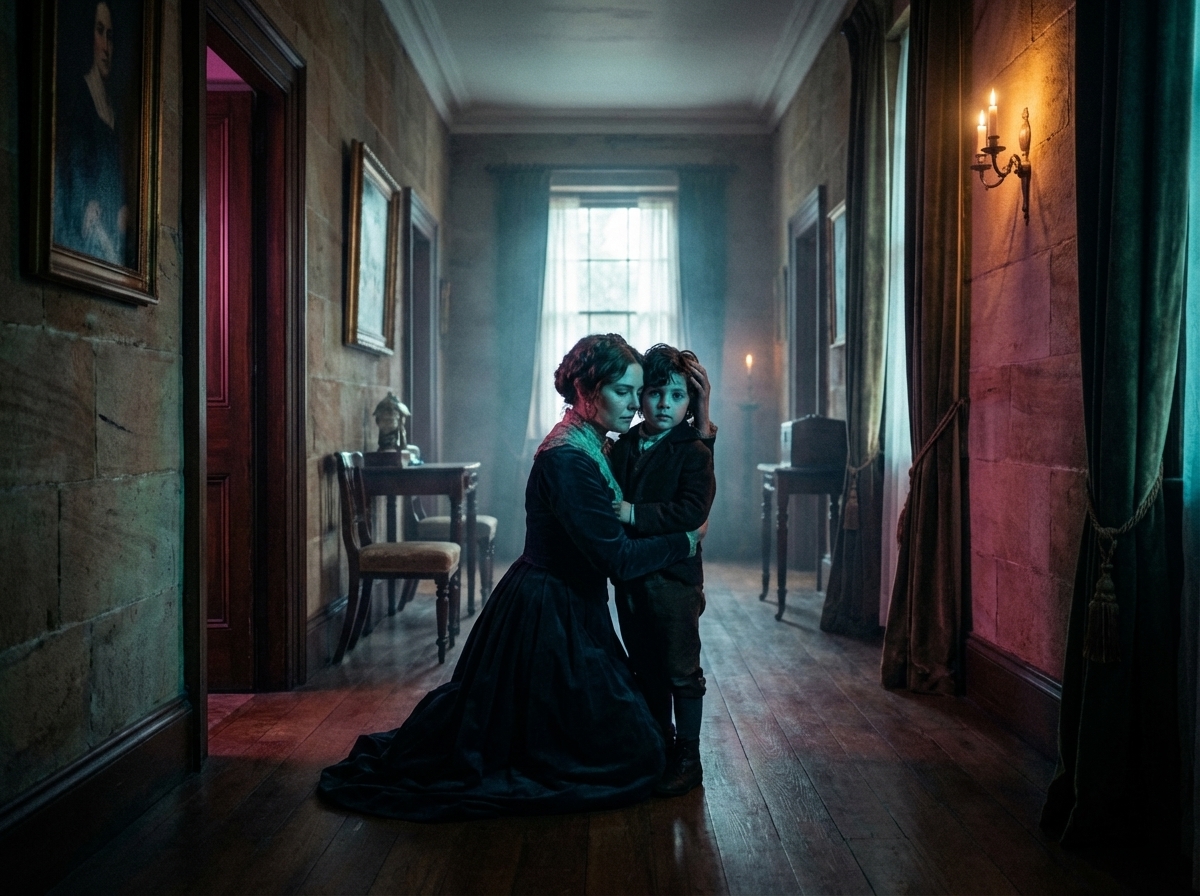
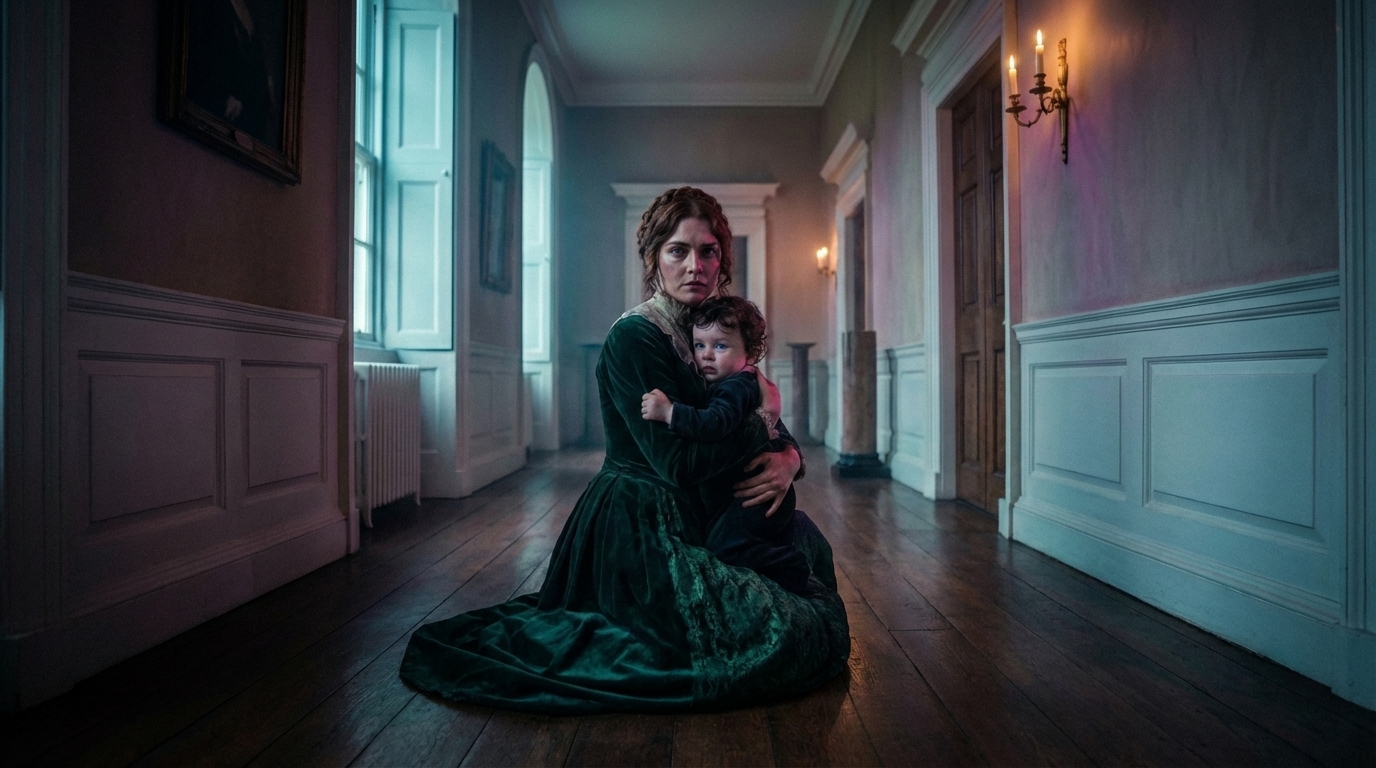
A boy who is not yet two years old reaches for his mother in a corridor and says one word. "Papa." She kneels. Her legs ache. She has already spent this morning screaming, searching, and weeping into the dirt floor of a cellar. She has found a hollowed-out book stuffed with damning financial records. She has learned that her cook heard voices and a thud in the east wing at midnight. She has washed the evidence from her face, smoothed her dress, reassembled herself into the mistress of a colonial manor, and she is holding — by a thread — the appearance of a woman who is merely concerned rather than a woman who is terrified. And now her son is looking at her with his father's blue eyes and asking where Papa is. She lies to him. That's the moment.
Welcome to the Clivilius Storiverse Podcast. I'm Nathan. And this is where I pull back the curtain on individual moments within the Storiverse — the people, the decisions, the collisions between ordinary lives and extraordinary circumstances. Each episode, I take one moment, and I unpack what's really going on beneath the surface. The psychology. The relationships. The things people do when the rules they've lived by suddenly stop applying.
Today: a woman called Madelyn Jeffries, a colonial manor in Van Diemen's Land, and the first lie a mother tells to protect her child.
THE WOMAN IN THE CORRIDOR.
The year is 1821. The place is Jeffries Manor — a Georgian sandstone estate on fifty acres along the Derwent River, near Granton, in what is still called Van Diemen's Land. It's an imposing property, built to project authority and permanence, the kind of house that tells the colony exactly what kind of man built it. Or what kind of man he wanted people to think he was.
Madelyn Bally was born in Portsmouth in 1795, a merchant's daughter. She married William Jeffries — a man of considerable charm and, as it would turn out, considerable secrets — and was swept to the untamed shores of Tasmania. She bore him a son, William Jr., in 1819. She ran his household with the precision expected of a colonial matriarch. And she knew things about her husband that nobody else knew.
On the morning of August 10th, 1821, she woke to find his side of the bed cold and untouched. He had left a letter — cryptic, warning her to trust no one. And then the house erupted.
By the time we reach this moment in the corridor, Madelyn has already lived several lifetimes in a single morning. She has screamed. She has searched. She has descended into the servants' quarters, then further into the cellar, where her composure finally shattered in the dirt and the dark. She has discovered a hollowed book in William's study containing hidden correspondence and financial records. She has learned from the cook that someone heard voices and a thud in the east wing around midnight. Her closest friend, Victoria Ashford, has arrived at the manor and is sitting in the drawing room with eyes that miss nothing.
And through all of it, Madelyn has had to perform. Because in 1821, in a colonial household, a woman's grief is never just grief. It is evidence. Every tear is scrutinised. Every silence is catalogued. Every word she speaks will be weighed against what people think they know and what she cannot afford to reveal.
THE BOY.
William Jeffries Jr. is not yet two years old. He has dark curls and blue eyes that shift between light and shadow in a manner so like his father's that grown adults catch their breath at it.
He knows none of what is happening. At his age, the world is bounded by nursery walls and familiar faces. Fathers disappear and reappear according to mysterious adult schedules. The greatest tragedy is a missed biscuit or a favourite toy temporarily mislaid.
His nanny, Miss Fletcher, has kept the nursery intact through the morning's chaos. She has kept him fed, calm, and shielded from the screaming and the searching and the servants' whispered conferences on staircases. Here he is — clean and cheerful, toddling alongside her with the determined unsteadiness of legs not yet confident in their purpose. His small world is intact.
And then he rounds the corner and sees his mother.
"Mama!"
The word hits Madelyn before she has properly registered where it came from. He reaches for her with chubby arms, his face bright with a joy that knows nothing of catastrophe. And something cracks in her chest.
THE EMBRACE.
Madelyn kneels. Despite the protest of muscles exhausted by the morning's strain, she gathers him into her arms with a fierceness that makes him squirm and laugh, thinking it a game.
And in her own account of this moment, she describes something extraordinary. She presses her face into his hair and breathes him in — the clean, milky scent of the nursery, warm linen, the faint sweetness of porridge, and beneath all that, a scent that is simply his. One she would know in a darkened room amongst a thousand children.
For a moment, she says, there is nothing else. No empty bed. No letter. No voices in the east wing. No Victoria in the drawing room with her watchful eyes. Just this. Just him. The solid, wriggling, living weight of her son in her arms.
He tolerates the embrace for about ten seconds. Then he pushes back with the imperious determination of the very young. He wants to see her face. Children are like that — they need to look at you when they speak, need to confirm that the world is arranged as they expect it to be.
And then he asks.
"Papa... breakfast. Where Papa?"
THE LIE.
The question strikes her, in her own words, like a blow to the sternum.
She has been dreading it since the moment she discovered the empty bed. But nothing could have prepared her for the innocent confusion in her son's voice. The simple expectation that surely there must be an answer. Surely Papa would appear if only the right words were spoken.
"Papa had to go away for a little while. But he loves you very much. You know that, don't you?"
The lie sits heavy on her tongue. And the boy considers it with the solemn gravity of the very young, his brow furrowing — and here it is again, that echo — in a manner so like his father's that her breath catches. Then he nods. Satisfied. For the moment.
Children are resilient in their innocence, Madelyn observes. They can accept explanations that would never satisfy an adult mind. But she knows that resilience won't last. In days, perhaps weeks, he will begin to notice the whispers and the worried glances. He will understand that something terrible has happened even if no one will explain what.
And she asks herself: what will she tell him then? What words exist for a child too young to comprehend betrayal or danger or the terrible ambiguity of a father who has vanished leaving only warnings and unanswered questions?
She kisses his forehead — that smooth, warm expanse of skin that still carries the softness of infancy — and releases him. He toddles a step away, then turns back and reaches for her hand. He wants to show her something upstairs. Blocks, maybe. A wooden horse. Whatever important business has captured his attention.
"In a moment, my love. Mama must attend to something first. But I shall come to the nursery later. I promise."
The promise feels reckless even as she makes it. She does not know what the next hour holds. But his face needs the promise, and so she gives it.
THE NANNY.
There's a secondary thread in this moment that I think is worth pulling, and it concerns Miss Fletcher.
After William Jr. is handed back, Madelyn finds herself studying the nanny with an attention she has never before directed at her. The woman is perhaps twenty-five. Fair hair beneath a plain cap. Eyes of indeterminate colour that watch without seeming to watch. A posture of professional patience so perfectly calibrated that it could mean anything or nothing at all.
Madelyn notes the steadiness of her expression. The careful positioning of her body — close enough to intervene if the child needs her, distant enough to afford the mistress privacy. The way her eyes move between mother and child, cataloguing the interaction with the professional attentiveness of a woman whose livelihood depends on reading the moods of the household.
What has she heard this morning? What has she surmised? She would have been in the nursery when Madelyn's scream tore through the house at dawn. She would have felt the household shift beneath her. And she managed it. Here the boy is — intact, cheerful, his small world preserved.
Madelyn is grateful for that. But the gratitude is threaded with unease. Miss Fletcher's competence — her ability to maintain composure whilst everything disintegrates around her — speaks to a self-possession that goes beyond mere training. And Madelyn, who has spent this entire morning calibrating her own performance, recognises a fellow performer when she sees one.
WHAT THE CORRIDOR HOLDS.
After the nanny leads William Jr. away, Madelyn stands alone in the corridor until their footsteps fade. The nursery door closes somewhere above. Miss Fletcher's muffled voice drifts down, speaking to the child in those calm, measured tones. Then nothing. Just the creak of the house settling. The distant sounds of the kitchen. Wind against the windowpanes.
She leans against the wall and presses her hand to her mouth. Not to stifle a sob — she is beyond weeping now, wrung dry by the morning. But to hold something in. Some sound or word or truth that presses against her lips with the urgency of confession.
William's letter echoes in her mind: "Whatever happens, whatever you may hear spoken about me in the days and years to come, never doubt that I love you both."
And here is what Madelyn understands, standing alone in a corridor in 1821 while a constable rides up the Hobart Town road towards her door: she does not doubt his love. But love, she is learning, can coexist with things dark enough to destroy everything it touches. And the child it was meant to protect — that small, trusting creature with his father's eyes and his mother's stubbornness — deserves better than the wreckage they are making of his world.
William Jr. will survive. He will grow up in that manor, in the shadow of his father's disappearance. He will study law at Cambridge. He will return to Tasmania and transform the family's controversial fortune into a respected colonial empire. And he will spend his final years consumed by an obsession with what happened to his father — the man who vanished one August morning and left nothing behind but a letter, a hollowed book, and a boy with his eyes.
But that is decades away. Right now, he is not yet two, and he is upstairs practising his letters because Cook has promised jam tarts for elevenses. He does not know the world is broken. He believes his father has gone away for a little while.
And his mother straightens. Draws her hand from her mouth. Presses her palm flat against the wall, feeling the solidity of the house her husband built. Smooths the front of her dress.
And turns toward the drawing room, where Victoria is waiting, and the performance must continue.
AND FINALLY.
Next time on the Clivilius Storiverse Podcast, we step into a different life, a different moment, a different corner of this world. That's how this works — every episode is a window into a single moment and the ripples it sends through the lives around it.
I'm Nathan. Thanks for listening. And if you've ever told a lie because the truth would have broken someone who trusted you — Madelyn would understand.