Episode 005: Wolves at the Supper Table
A seventeen-year-old girl walks through the door of her family's tenement, and her nine-year-old sister nearly knocks her off her feet. It's been one day. She left this morning for her first day of work at an Edinburgh fashion house, and she's come back a different person. She's spent the last twelve hours learning to press silk and keep secrets. She's watched a noblewoman pass hidden documents through a dress fitting. She's been told that the last apprentice who asked too many questions simply vanished. She's walked home through Edinburgh's closes with the distinct feeling of being followed, a stranger's perfume clinging to the air behind her. And now she's standing in a cramped room that smells of peat smoke and beef stew, with her little sister's arms around her waist and the weight of a world she can't explain pressing against the inside of her ribs. She's going to have to talk about her day. She's going to have to lie. That's the moment.
Welcome to the Clivilius Storiverse Podcast. I'm Nathan. And this is where I pull back the curtain on individual moments within the Storiverse — the people, the decisions, the collisions between ordinary lives and extraordinary circumstances. Each episode, I take one moment, and I unpack what's really going on beneath the surface. The psychology. The relationships. The things people do when the rules they've lived by suddenly stop applying.
Today: a supper table in Edinburgh, a name that shouldn't have been spoken, and four sisters who will one day build a civilisation — though none of them know it yet.
THE FIRSTBORN.
Elspeth Stewart was born on the 17th of May, 1738, in Edinburgh. Her father, Angus, was a blacksmith. Her mother, Morag, a seamstress from Glenfinnan who had met Angus at a cattle fair in 1735. There were four daughters — Elspeth the eldest, then Effie, Katrina, and Violet — and a household that ran on warmth, stubbornness, and not quite enough money.
Then Angus died, in 1754. Elspeth was sixteen. The family didn't collapse — the Stewarts weren't built for collapse — but they tilted, hard, and the weight of keeping four lives upright settled onto Elspeth's shoulders because there was nobody else.
The apprenticeship at Moira MacKenzie's Emporium of Fashion was supposed to be survival. A wage. Respectable work in a prestigious establishment. Enough to keep the family fed while the younger girls grew into something resembling independence.
But the Emporium is not what it appears to be. Elspeth has understood that within hours of walking through its doors. The fabrics are real, the gowns are extraordinary, the clients are among Edinburgh's most powerful women. But beneath the silk and the fitting rooms and the professional courtesy, something else is running. Information moves through that building like thread through a needle — whispered, folded, hidden in pockets that shouldn't exist.
And Elspeth, who arrived that morning knowing nothing, is already learning the Emporium's first and most important rule: what you see is never all there is.
THE SUPPER TABLE.
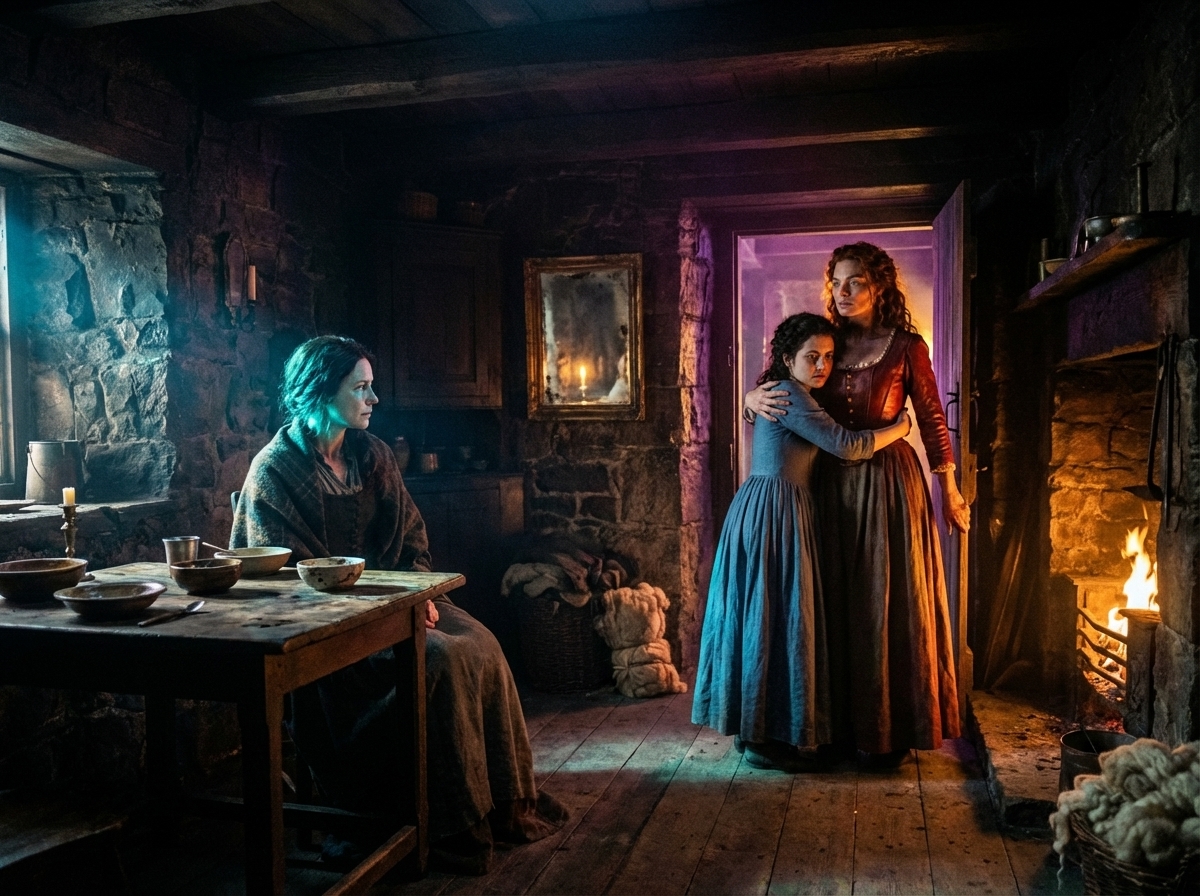
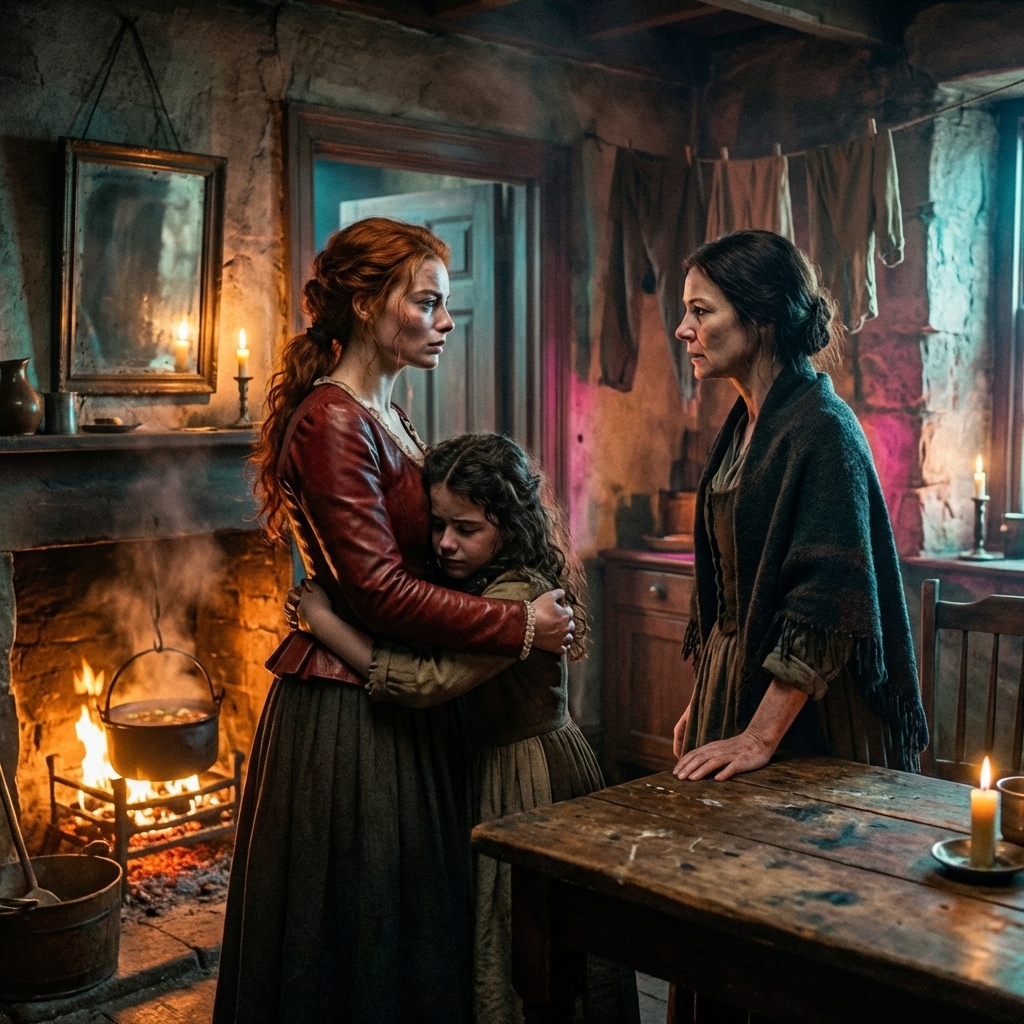
The Stewart family home is exactly what you'd expect for a blacksmith's widow and four daughters in mid-eighteenth-century Edinburgh. Close walls. Worn floorboards. A table scarred with the history of every meal the family has shared. A family heirloom mirror, tarnished with age. A hearth fire that holds back the April chill but can't quite warm the corners.
Violet reaches Elspeth first. She's nine — all bouncing curls and uncomplicated adoration. She collides with her sister in the doorway with enough force to stagger her, and the effect is immediate: the tension Elspeth has been carrying since she left the Emporium begins, just slightly, to ease.
But not entirely. Because even as Violet chatters and Effie looks up from her mending with amused patience and Katrina emerges clutching a book like a talisman, Elspeth is already doing calculations. What to share. What to omit. How to describe the Emporium's wonders without revealing its shadows.
This is the first time Elspeth Stewart edits her own story for the people she loves most. It won't be the last.
CAREFUL OMISSIONS.
The family settles around the table and Elspeth talks. She describes Moira MacKenzie with her regal bearing and grey eyes. She describes Agnes Fraser, the senior seamstress. She talks about the fabrics — silks that change colour when you move them, lace so fine it looks like it was spun by faeries, velvets you could lose yourself in.
Violet is enchanted. "It sounds magical," she sighs. "Like something out of a fairy tale."
And Katrina — eleven years old, serious as a judge, clutching Miller's Gardener's Dictionary and correcting metaphors about faeries with the precision of a born scholar — murmurs something barely audible from across the table: "Fairy tales have a habit of containing wolves and witches."
Nobody catches it but Elspeth. And the line lands with a weight that Katrina can't possibly intend, because Katrina doesn't know what Elspeth knows. She doesn't know about the hidden pockets in the gowns. She doesn't know about the vanished apprentice. She doesn't know about the stranger in the close who smelled of Emporium perfume.
But she's right. The fairy tale does contain wolves.
Effie, thirteen, is less interested in magic than in fashion. She wants to know about London styles, about the enormous skirts that require women to turn sideways through doorways. And Elspeth obliges — because fashion is safe territory, because talking about brocade and silk is easier than talking about what she saw folded into its seams.
THE NAME.
And then Elspeth makes a mistake.
She mentions Lady Aberfoyle. Casually — in the context of a midnight blue silk gown being prepared for a soirée. A beautiful dress for an important client. Nothing more.
The table goes silent.
Elspeth looks up to find her mother and Katrina exchanging a glance — one of those wordless communications between people who share a vocabulary the rest of the room hasn't learned. It lasts half a second. It says everything.
"Lady Aberfoyle, you say?" Morag's voice is carefully neutral. Too carefully. "That's... interesting."
Elspeth's spoon pauses halfway to her mouth. "Do you know her, Mam?"
"Not personally, no." The denial comes too quickly. Morag's eyes dart to the window — shuttered against the evening chill — and for a moment she looks not like a mother at a supper table but like a woman checking the perimeter. "But one hears things, working in the houses of the well-to-do. Lady Aberfoyle has quite the reputation."
And here is where the moment pivots. Because what follows is a conversation conducted almost entirely in subtext — Morag warning without explaining, Katrina contributing fragments of political context in her careful, measured voice, Violet mercifully distracted by the family cat, and Elspeth realising, with a chill that has nothing to do with the April air, that the world she stepped into this morning has roots that reach all the way home.
DREAMS THAT SOME WOULD CALL TREASON.
Morag Stewart was born in Glenfinnan in 1716. That date matters. She grew up in the Highlands during the aftermath of the Jacobite risings. She knew what political danger looked like — not from books, not from theory, but from the marrow of her bones. And she'd married a blacksmith and moved to Edinburgh and raised four daughters and kept her head down and her mouth shut, because that was how you survived when the wrong word to the wrong person could bring soldiers to your door.
And now her eldest daughter has walked into a fashion house that trades in secrets, and mentioned the name of a woman connected to exactly the kind of politics that Morag has spent a lifetime trying to avoid.
"These are dangerous times," she tells Elspeth, her grip tight on her daughter's hand across the scarred table. "And the Emporium may be more than it seems. One careless word in the wrong ear could bring disaster not just on yourself but on all of us."
She makes Elspeth promise to keep her head down and her ears closed.
Elspeth promises. And even as the words leave her mouth, she knows the promise is hollow — not because she intends to break it, but because it's already too late. Her ears have been open all day. She's heard things that can't be unheard, seen things that can't be unseen. Keeping her head down was never really an option, and both she and her mother know it.
What Morag doesn't know — what she can't know, because the Storiverse is not a story anyone can see the end of while they're living it — is what her daughters will become. All four of them. Every girl at that table. Elspeth, the eldest, will one day be First Guardian of New Edinburgh. Effie, the diplomat, will build the trade networks that keep a new civilisation alive. Katrina, the scholar, will transform barren soil into agricultural abundance. And Violet — wee Violet, who is nine years old and wants a bedtime story with a happy ending — will become the architect who shapes a settlement from raw wilderness.
Every one of them will cross into Clivilius. Every one of them will be appointed Guardian. And every one of them will draw on the lessons they learned in this room — at this table, in this firelight, from this mother — to build something that Morag herself will never fully understand.
But that's decades away. Tonight, they are four girls and a widow, eating stew from chipped bowls, and the wolves are only just beginning to circle.
THE BEDTIME STORY.
After the plates are cleared and the conversation turns to lighter things — Effie's embroidery, Mrs MacPherson's goat in the kirkyard, a dream Violet had about a talking fish and a castle made of cheese — the evening gentles itself into something resembling ordinary.
But Elspeth catches her own reflection in the tarnished mirror on the wall, and the face looking back seems different. Older. More serious. There is a spark of something new in her eyes that was not there this morning.
Then Violet tugs at her sleeve. The cat is draped over her shoulder like a purring shawl. "Elspeth? Will you tell me a story before bed? A proper one, with adventures and princes and happy endings?"
And Elspeth looks down at that upturned face — so full of hope and trust — and feels something tighten in her chest. Whatever secrets are gathering around her, whatever dangers are coiling in the shadows of the Emporium and beyond, this is what matters. This is what she's fighting to protect.
"Aye, Wee Vi," she says, taking her sister's hand. "I'll tell you a story. The best one I know."
She leads Violet towards the bedroom. She feels her mother's eyes on her back — watching, worrying, wondering what storms might be gathering.
She does not look back. Some burdens are too heavy to share, even with those you love most.
And later that night, after the household sleeps, Morag will be waiting. She has something to tell Elspeth. Something about the portrait above the mantel, and the man it depicts, and the dark roots that connect the Emporium's secrets to the Stewart family's own.
But that's another moment. For now, there is a bedtime story to tell. And Violet has requested a happy ending.
AND FINALLY.
Next time on the Clivilius Storiverse Podcast, we step into a different life, a different moment, a different corner of this world. That's how this works — every episode is a window into a single moment and the ripples it sends through the lives around it.
I'm Nathan. Thanks for listening. And if you've ever edited your own day to protect the people at your table — Elspeth would understand perfectly.