
Episode 016: Needle and Nerve
A seventeen-year-old girl is standing in front of a door in Edinburgh. Her best dress is dark green wool. It's seen better days. Her boots are worn through at the soles. Her hair is pinned into a style she practised for hours the night before, arms aching above her head, desperate to get it right. Her hands are trembling. She hasn't eaten today. Her father has been dead less than a year. Her mother is a widow with four daughters. And behind this door is a job that could save all of them — or prove, in the first five minutes, that she doesn't belong. She pushes the door open anyway. That's the moment. Not what she finds inside. The push.
Welcome to the Clivilius Storiverse Podcast. I'm Nathan. And this is where I pull back the curtain on individual moments within the Storiverse — the people, the decisions, the collisions between ordinary lives and extraordinary circumstances. Each episode, I take one moment, and I unpack what's really going on beneath the surface. The psychology. The relationships. The things people do when the rules they've lived by suddenly stop applying.
Today: a door, a first day, and the moment your hands stop trembling — not because you've stopped being frightened, but because you've found something to do with them.
THE WEIGHT OF FIRST DAYS.
I want to talk about what it feels like to walk into a place where you don't belong. Not metaphorically — physically. The actual bodily experience of crossing a threshold into somewhere that operates by rules you haven't learned yet, where everyone can see that you're new, where your clothes are wrong and your voice sounds small and the room itself seems to be quietly assessing whether you deserve to be in it.
Everyone has had this day. The first day at a school where you don't know anyone. The first morning in an office where the coffee machine has buttons you don't understand and the people around you are performing a fluency you can't fake. The first time you walk into a room full of people who are better dressed, better connected, more confident, more everything — and you have to pretend that the gap between you and them isn't visible from across the room.
Elspeth Stewart has this day in April 1755. She's seventeen. Her father, Angus, was a blacksmith who died in an accident at the smithy less than a year ago. His death didn't just take him — it revealed debts nobody knew about, and the family that was merely modest before is now quietly desperate. Elspeth's mother, Morag, has been fading since the funeral. Her three younger sisters — Effie at thirteen, Katrina at eleven, Violet at nine — are growing up too fast in the shadow of a loss they're each processing at different speeds.
Elspeth has been carrying things her mother doesn't know about. Going to bed hungry so her sisters can eat. Calculating costs in her head before anyone at the table notices. Holding the family's financial reality in a compartment she doesn't share, because sharing it would mean admitting that the person responsible for holding them together doesn't know how to hold them together.
And now she's walking through Edinburgh in worn boots on rain-slicked cobblestones, heading for an apprenticeship at the most prestigious fashion house in the city. A place where silk from Cathay hangs on polished racks and women who've never missed a meal make garments for other women who've never missed a meal. A place that could change everything — if she can get through the door without falling apart.
THE ROOM THAT SEES YOU.
The thing about entering a place where you don't belong is that the place knows before you do.
Elspeth describes the Emporium as overwhelming — silks, lace, the smell of lavender and beeswax and something foreign she can't name. But the detail that matters isn't the grandeur. It's the eyes. The mannequins in the window seem to follow her. The employees she passes on the way through — a man arranging cravats, an older woman measuring fabric as though counting every thread — all of them notice Moira walking with a stranger, and all of them look away just slightly too fast.
This is something that rarely gets discussed about first days: the surveillance. Not hostile surveillance — just the ambient awareness of a group that has its rhythms, its hierarchies, its unspoken rules, suddenly registering the presence of someone who doesn't yet know any of them. You feel it on your skin. The room is reading you before you've had a chance to introduce yourself, and it's reading everything — your posture, your shoes, the way you hold your hands, the speed at which you walk, whether you look people in the eye or look at the floor.
Elspeth looks people in the eye. She lifted her chin on the walk here, when she saw the sidelong glances at her threadbare cloak, and she hasn't lowered it. Not because she's confident. Because her dead father taught her that a Stewart faces what lies ahead with shoulders square. The confidence is performed. The trembling is real. But the performance matters, because the performance is what the room sees, and what the room sees is what gets filed as first impression.
There's a courage in performing composure you don't feel. It's not dishonesty. It's the decision to present the version of yourself that can survive this room, even though the version underneath is terrified. Every person who's ever walked into an interview with a rehearsed smile while their stomach was in knots knows exactly what Elspeth is doing. You're not lying. You're building a bridge between who you are and who the room needs you to be, and you're crossing it in real time, one step at a time, hoping it holds.
THE WOMAN WITH STORM-GREY EYES.
Moira MacKenzie appears from behind a counter and says four words: "Miss Stewart, I presume?"
And in that moment, Elspeth encounters something she has no framework for. Not unkindness — Moira isn't unkind. Not warmth — Moira isn't warm. Something else. The experience of being seen, completely and without sentiment, by someone whose assessment you cannot influence through charm or effort or the performance of composure.
Moira's eyes are grey. Elspeth returns to them repeatedly in her account. Storm clouds. Full of portent. They miss nothing. And what Elspeth feels under that gaze is the specific discomfort of being read by someone who reads professionally — who catalogues weaknesses and strengths and potential with the same precision she applies to fabric.
"You are punctual, at least," Moira says. "That is a quality I value highly."
And Elspeth feels a flicker of warmth at this. Not because it's generous praise — it isn't. Because it's real. From a woman who gives nothing freely, even this acknowledgement is significant. Elspeth thinks of her father: "A Stewart is never late." And the memory brings a lump to her throat that she forces down, because now is not the time for sentiment. Now is the time for strength.
This is something I think matters deeply and is almost never spoken about: the hunger for honest assessment when you're in a new environment. Not praise — assessment. When everything is unfamiliar and you can't tell whether you're succeeding or failing, the cruelest thing anyone can do is be vague. "You're doing fine." "We'll see how it goes." These are the phrases that leave you stranded in uncertainty, unable to calibrate. What Moira gives Elspeth — "you are punctual, at least" — is specific, honest, and bounded. It tells Elspeth exactly one thing she's doing right, which means the things she hasn't been told are the things she still needs to prove. It's the assessment equivalent of a map with one location marked on it: not much, but enough to orient yourself.
THE MOMENT THE TREMBLING STOPS.
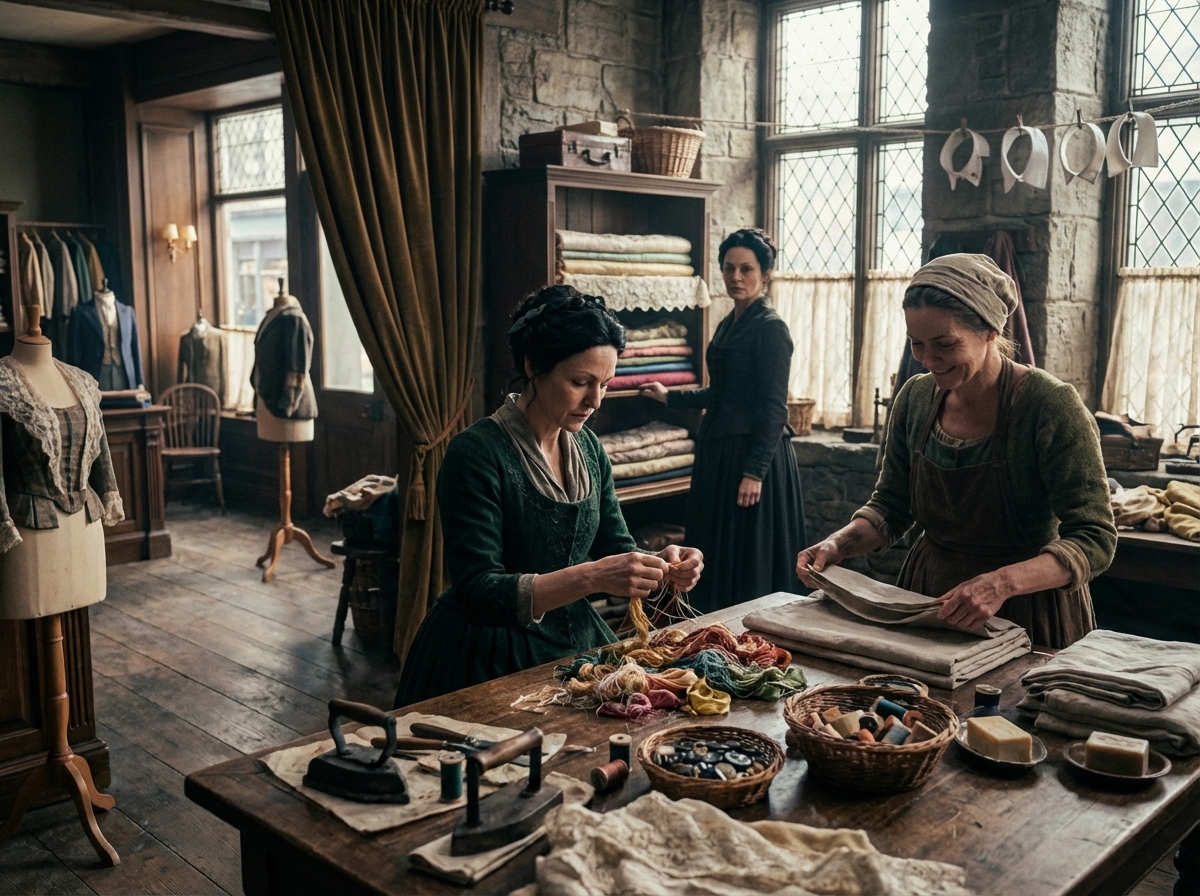
Moira leaves. Agnes Fraser — honey-coloured eyes, work-roughened hands, the practical kindness of someone who has been exactly where Elspeth is standing — shows her to a seat at the worktable. The room smells of soap and starch and silk. The other seamstresses resume their work, their curiosity visible but held in check.
And Elspeth picks up her first task: sorting a tangled mass of silk threads into their proper colours. A rainbow in disarray. Scarlet, gold, cerulean, violet. Threads finer than anything she's worked with, slipping through her fingers like whispered promises.
And here is the detail that holds the entire morning. One sentence in a long account, easy to miss if you're not paying attention:
Her hands have stopped trembling.
Not because she feels confident. Not because the fear has gone. Not because Moira's assessment has reassured her or Agnes's kindness has settled her or the room has declared her welcome. The trembling stops because her hands are busy. Because the task — sorting thread by colour, separating strand from strand — is something she understands. Not the Emporium. Not the politics. Not the storm-grey eyes or the velvet curtain or the secrets she can already sense lurking behind the silk. Just this: the physical act of doing something she knows how to do, in a room full of people doing the same thing, with light coming through a high window and dust motes turning slowly in the air.
This is the truth about first days that nobody tells you in advance. The trembling doesn't stop when you feel ready. It stops when you start working. When your hands find a task and your body remembers what competence feels like and the muscles that were locked with anxiety release because they're being used for something other than holding themselves still.
It's why people who are terrified on the first morning are often fine by lunch. Not because the terror has resolved — it hasn't. Because the work has arrived. Because the thing they were hired to do turns out to be something they can do, and doing it creates a rhythm that the fear can't quite interrupt. The hands know what they're doing even when the mind is still panicking. And eventually, the mind catches up.
Elspeth sits at a scarred table in a workroom behind a velvet curtain in Edinburgh's most prestigious fashion house, sorting silk threads she can't afford to drop, surrounded by women whose names she'll forget by the end of the day, working for a woman whose eyes see everything — and the trembling has stopped. Not because she belongs here. Because she's begun.
THE BELL.
Somewhere in the shop, a bell chimes as a customer enters. The sound reaches the workroom from what seems like another world entirely — the world Elspeth left behind when she pushed open that door this morning. The world of rain-slicked cobblestones and threadbare cloaks and sidelong glances. The world where a dead father's debts are piling up and a mother is fading and three sisters are waiting at home for news of how the first day went.
That world is still there. It hasn't gone anywhere. The bills are still unpaid. The shoes are still worn through. Violet is still asking questions nobody can answer. Nothing about Elspeth's circumstances has changed because she sat down at a table and sorted silk.
But something about Elspeth has changed. She has discovered that she can walk into a room that doesn't belong to her and survive it. That she can be assessed by storm-grey eyes and not crumble. That she can sit among women who have been doing this work for years and pick up a thread and hold it steady. That the trembling stops.
That's not a small thing. For a seventeen-year-old carrying her family on her shoulders, standing in the gap between ruin and survival, with nothing but a pair of worn boots and a dead man's pride to get her through — the discovery that the trembling stops is everything. It means she can come back tomorrow. It means the door she pushed open this morning is a door she can push open again. It means the threshold has been crossed, and whatever comes next — whatever secrets this place holds, whatever Moira MacKenzie's eyes see that others don't — she has begun.
She bends her head over the silk and continues sorting. One colour at a time.
AND FINALLY.
Next time on the Clivilius Storiverse Podcast, we step into a different life, a different moment, a different corner of this world. That's how this works — every episode is a window into a single moment and the ripples it sends through the lives around it.
I'm Nathan. Thanks for listening. And if you've ever walked into a room where you didn't belong and found that the trembling stopped the moment your hands had something to do — that's not confidence. That's the beginning of it. And the beginning is always enough.