Episode 006: Idling
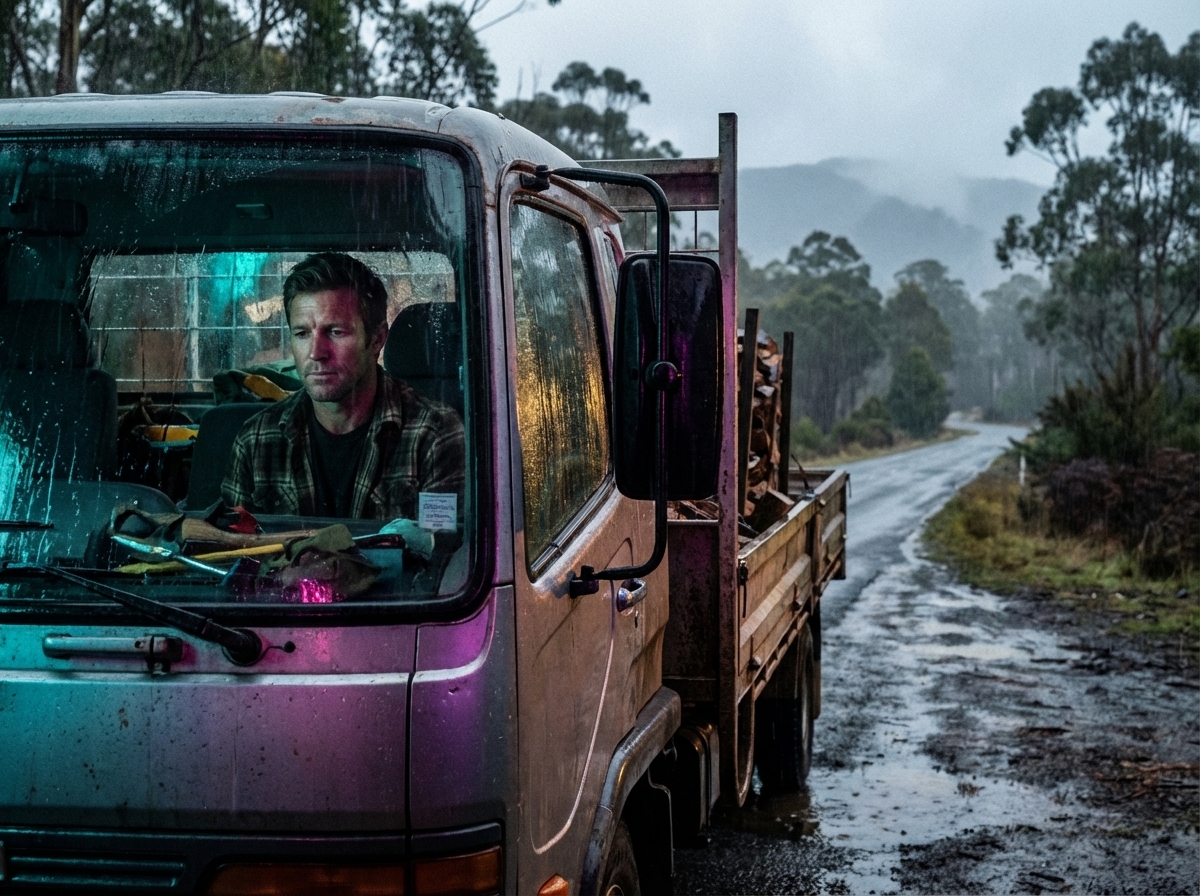
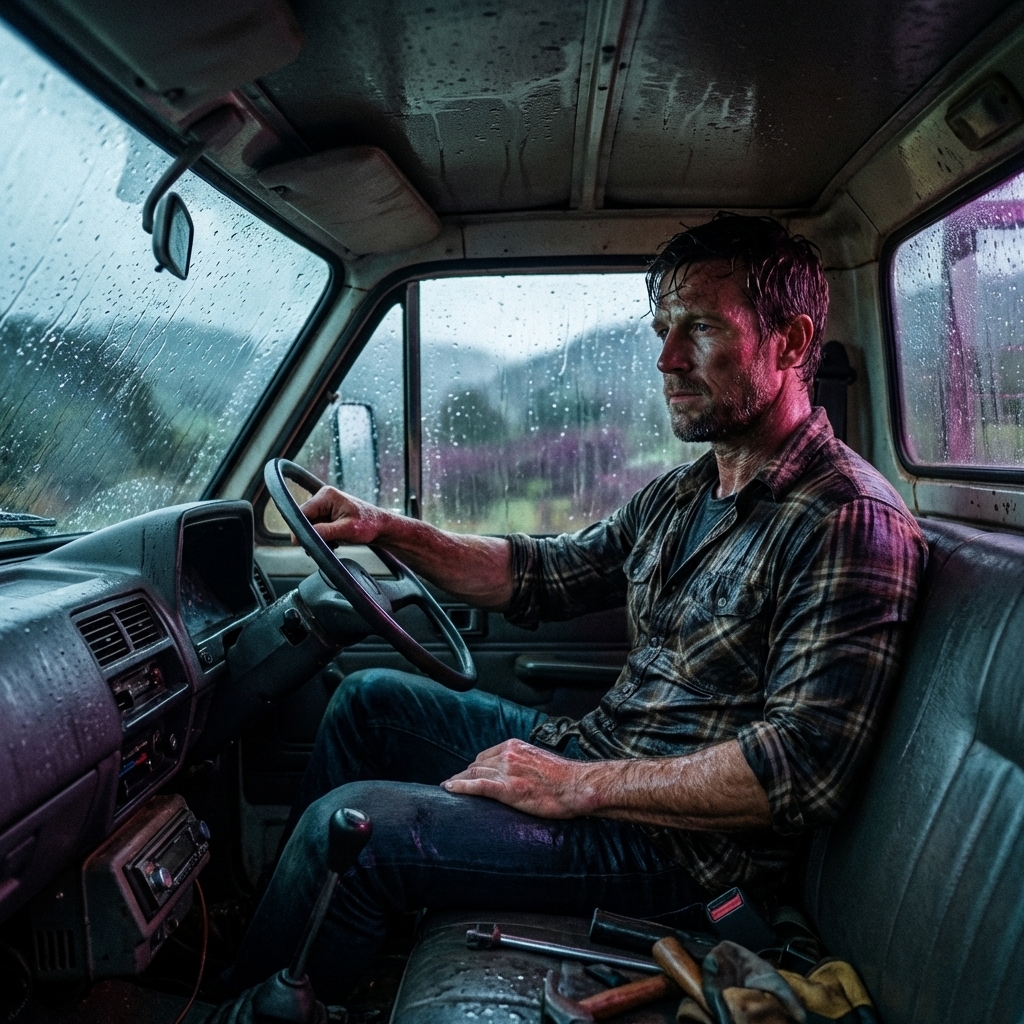
A forty-five-year-old man is sitting in the cab of a firewood delivery truck, parked in a lay-by on an empty road in rural Tasmania. His clothes are soaked through. The heater's dead. The windows are fogged solid. His last delivery just got cancelled by text message. He has nowhere to be and no reason to move. In his shirt pocket there's half a joint his mate gave him earlier. It's still dry. He lights it. And inside that fogged cab, sealed off from the world by a storm that doesn't care who he is or what he's done, Jim Hedger stops pretending that the morning didn't leave a mark. That's the moment.
Welcome to the Clivilius Storiverse Podcast. I'm Nathan. And this is where I pull back the curtain on individual moments within the Storiverse — the people, the decisions, the collisions between ordinary lives and extraordinary circumstances. Each episode, I take one moment, and I unpack what's really going on beneath the surface. The psychology. The relationships. The things people do when the rules they've lived by suddenly stop applying.
Today: a firewood truck, a rainstorm, and a man alone with a memory he can't put down.
THE LUMBERJACK.
Jim Hedger can tell you the age of a tree from the sound the axe makes. He can read a driveway the way other men read faces. He married Karen Mitchell at twenty-two, buried his father without ceremony, and has spent several decades arriving on time and leaving without lingering. He runs Hedger Wood Delivery Services out of Collinsvale — a firewood business built from his father's timber work, sustained across decades through straightforward reliability and an unhurried competence that his clients depend on without thinking about it.
He is the man everyone in Collinsvale relies on and nobody truly knows. And that's been fine. That's been the architecture of his entire adult life. Do the work. Deliver the wood. Come home. Don't linger. Don't complicate.
Jim is not a complicated man. But that is not the same as being a simple one. And this afternoon — this rain-soaked, fogged-in, nowhere-to-go afternoon in a lay-by on an empty Tasmanian road — is the moment where the distinction becomes impossible to ignore.
THE MORNING BEFORE.
To understand what happens in the cab, you need to know what happened before the cab. Earlier this morning, Jim kissed Gladys Cramer.
Not a peck. Not an accident. A real kiss — his hand on her cheek, her breath catching, the taste of wine and cold air and adrenaline. It lasted one second, maybe two, before she pulled back. And then it was over. Throat-clearing. The cold air flooding the gap between them. The moment folding up and dying.
Gladys Cramer. If that surname sounds familiar, it should. She's Beatrix's sister. And she is not Jim's wife.
Jim has been married to Karen for twenty-three years. They have a son, Thomas, who's at the age where he notices things and asks questions. Jim is a man whose self-image is built on reliability, on doing the right thing, on being the person who shows up and doesn't make a mess. And this morning he kissed someone else's mouth and the taste of it is still on his tongue and he cannot, no matter how many deliveries he runs or how hard the rain falls, make it go away.
THE STORM.
The storm has been building all morning. By the time Jim finishes his second delivery — a load dumped at the Proctors' place in Glenfern, a soaking, a thermos of tea from Keith Proctor who knows better than to waste words on weather — the road back is a river. He pulls into a lay-by and waits.
Then Corey texts. The last delivery's been rescheduled. Don't bother coming back. Weather's shot. He's closing up. Pepper steak for dinner.
Weather's, Jim thinks, correcting the apostrophe in his head. Then: good.
Because what "good" means, in this context, is that the rest of the afternoon is his. No third delivery. No reload. No reason to be anywhere. Just the truck, the rain, and a stretch of empty road that nobody else is using.
And here's where the moment crystallises. Because Jim Hedger, who has spent his years filling every available hour with work and routine and forward motion, suddenly has nothing to do. Nowhere to go. No task to absorb the energy that the morning generated and the afternoon has nowhere to put.
The cab fogs in under a minute. The windows go opaque. The world outside ceases to exist. And Jim is left alone with the one thing he's been running from all day: himself.
THE JOINT.
The half-joint is in his shirt pocket. Adrian's — pinched clean at the burned end, still dry, warm from sitting against Jim's chest all morning. He hasn't smoked in months. Karen doesn't mind it occasionally but she minds the smell in the truck, and Thomas asks questions.
But Thomas isn't here. Karen isn't here. Nobody is here.
Three flicks of a cheap Bic lighter and the smoke is in his lungs. Warm. Softer than tobacco. Sweet and earthy. He holds it. Feels the expansion against ribs that are still damp and cold beneath his clinging shirt. Lets it out in a slow stream that curls against the fogged windscreen and disappears.
The second drag loosens his shoulders. His jaw unclenches — he hadn't noticed it was clenched. His hands settle heavy and warm in his lap.
The third drag changes the rain. Not in reality — it's still hammering — but in his perception. The sound deepens, becomes textured. The roof of the cab becomes an instrument. He can hear the variations: the heavy strikes on the flat panels, the lighter patter near the windscreen, the sharp crack of a drop hitting the wing mirror. He's never thought rain was beautiful before. It's probably not the right word. But it's the one he has.
WHAT THE BODY REMEMBERS.
And this is where Jim's account gets bracingly honest. Because what the weed does — what it always does — is lower the defences. The careful architecture of not-thinking that Jim has maintained all morning starts to dissolve. And what comes through the gap is not a thought. It's not a decision to think about anything. It's a body memory.
Gladys arrives the way the rain arrived. Without warning. Without permission. Already fully present before he can do anything about it.
The feel of her cheek under his palm. Cool skin, fine-boned, a faint tremor running through her jaw. The way she'd craned her neck to look up at him. The expression on her face — raw, unfinished, something she hadn't meant to show anyone. Her breath against his mouth in the last half-second before he closed the gap. Warm. Unsteady. Catching.
And the taste. Wine and cold air and adrenaline, and underneath all of it something that was just skin, just mouth, just her — a taste he had no right knowing and can't unknow now.
Jim's account of what follows is unflinching. He doesn't prettify it. He doesn't dress it up in justification or self-loathing. He describes what his body does with the same matter-of-fact precision he'd use to describe stacking a woodpile. The arousal. The decision — or the absence of decision, which amounts to the same thing. The rain sealing the cab shut. The fog on the glass. The absolute privacy of being the only human being inside a kilometre of weather that nobody wants to be in.
What makes Jim's account extraordinary is not what he does — which is ordinary, and human, and exactly what millions of people do when they're alone with a memory they can't outrun. It's the clarity with which he observes himself doing it. He watches his own hands. He notes the way the cold belt buckle feels. He registers the contrast between the cold air and the heat of his own body. He is simultaneously the man inside the experience and the man watching the man inside the experience, and neither version of him can stop it or wants to.
AFTERMATH.
The rain doesn't stop. It never stopped. It was there before Jim pulled into the lay-by and it's there after, hammering the roof with the same relentless indifference.
He sits in the aftermath. The joint has burned to a stub. The cab smells of smoke and wet wool and the sharp, private aftermath of a body that just did what it needed to do. He cracks the window an inch. Rain spits through and hits his face — cold, sharp, welcome. He lets it.
Keith Proctor's thermos still has a mouthful of tea in it. Lukewarm now. Too sweet, the way the old man always makes it. Jim drinks it and sits with the taste — over-sugared tea in a cab that now smells like a teenager's bedroom and a forest floor and a mistake he's going to carry in his body for longer than the weed will last.
And then this line, from Jim's own account, which I think is one of the most quietly devastating things anyone in the Storiverse has ever said: he sat there, not thinking, not regretting. Just sitting in the fog and the noise and the aftermath, letting the rain do what it did, which was fall without caring who was underneath it or what they'd done.
That's Jim. That's the whole man in a single sentence. He doesn't dramatise. He doesn't moralise. He doesn't spiral into guilt or self-justification. He just sits in it. The way he sits in everything — weather, work, silence, the slow accumulation of a life lived without examining it too closely. The rain falls. He's underneath it. It doesn't care. And for right now, that's enough.
THE MAN IN THE LAY-BY.
There's a version of this moment that's just a man having a wank in a truck. Crude, forgettable, unremarkable. And if you strip away everything else, that's technically what happened.
But Jim's account doesn't let you strip it away. Because what's actually happening in that fogged cab is a man confronting something he's spent his entire adult life avoiding: the possibility that the life he's built — the reliable deliveries, the solid marriage, the unhurried competence — might not be enough. That something in him wants what it wants regardless of what he's decided he's allowed to have. That Gladys Cramer's mouth against his wasn't an accident or a moment of weakness. It was a door opening onto a room he didn't know was there.
Jim Hedger is not a man who opens doors. He delivers firewood. He comes home. He doesn't linger. That's been the deal. That's been the architecture.
And the rain keeps falling, and the architecture holds — for now. He does his belt back up. He drives home to Karen and the kids. The day ends the way days always end, with routine absorbing what honesty would destroy.
But the taste doesn't go away. Jim knows it. He says as much — not dramatically, not with any particular anguish, but with the flat, clear-eyed certainty of a man who has spent forty-five years understanding the properties of wood and weather and is only now beginning to understand the properties of himself.
Somewhere in Collinsvale, a firewood truck is parked in a driveway with fogged windows and a cold engine. The rain is easing. The day is over. And Jim Hedger is carrying something he can't stack, can't split, and can't deliver to someone else's doorstep.
AND FINALLY.
Next time on the Clivilius Storiverse Podcast, we step into a different life, a different moment, a different corner of this world. That's how this works — every episode is a window into a single moment and the ripples it sends through the lives around it.
I'm Nathan. Thanks for listening. And if you've ever sat in a parked car longer than you needed to, waiting for something inside you to settle before you went home — Jim would understand.