Episode 007: Dark Gifts
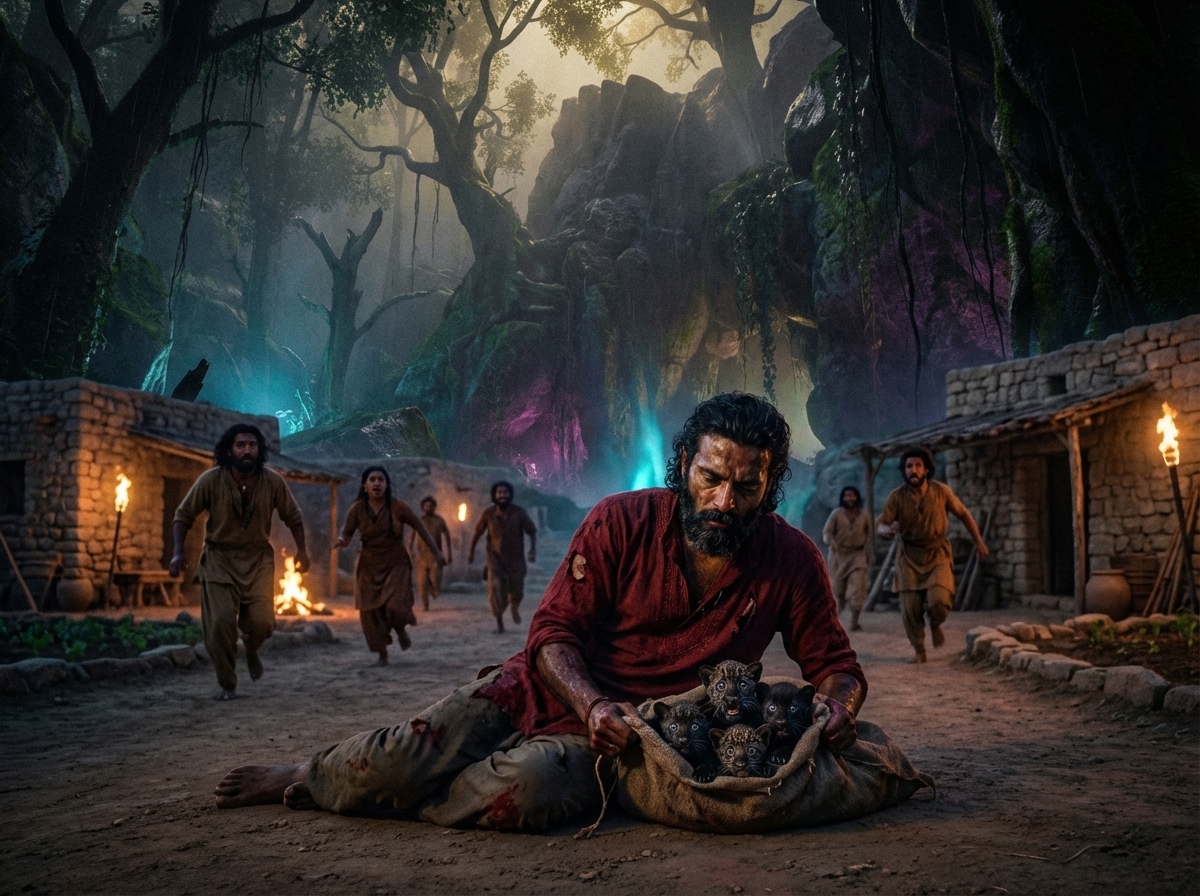
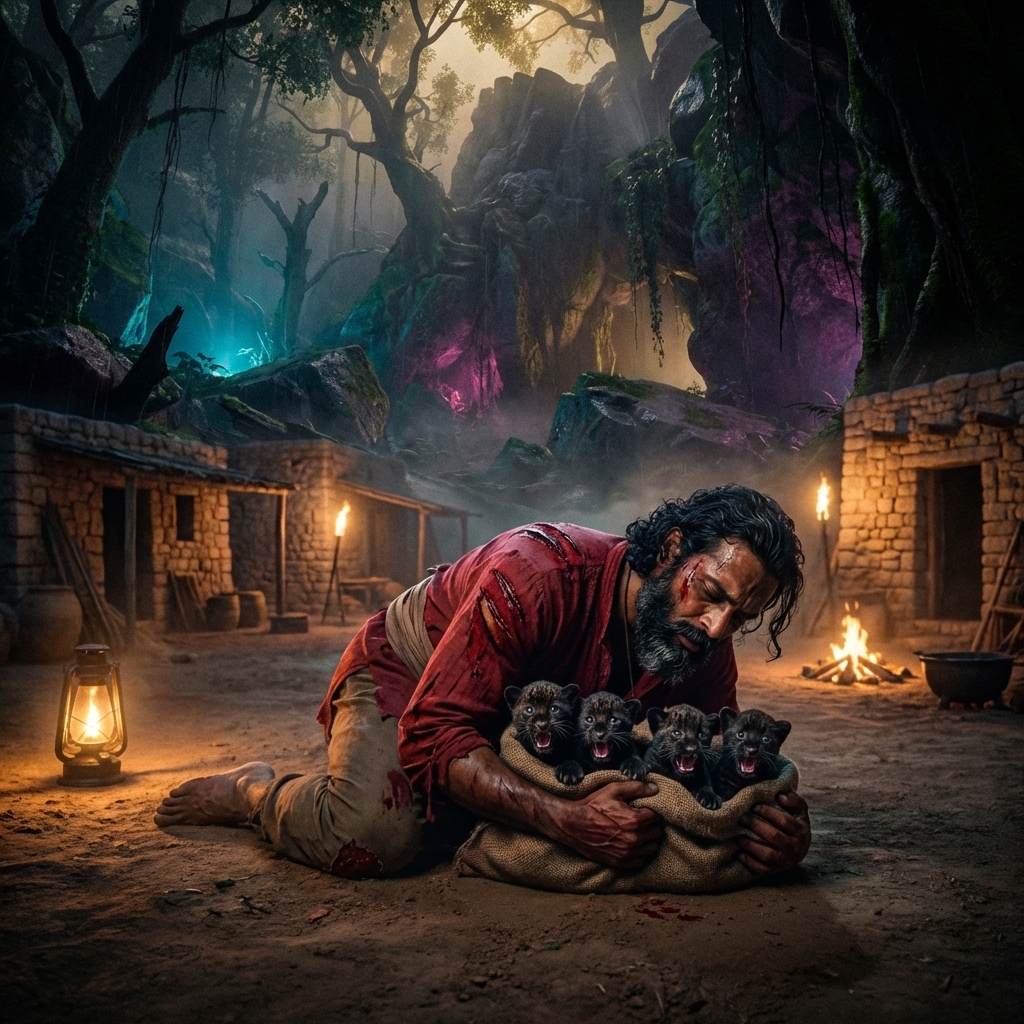
Thirteen hundred years before Christ was born, a man with claw marks down his back carries a sack of four mewling leopard cubs through a tear in reality and into another dimension. He collapses on the other side. His legs give out on the packed earth of a settlement called Andhakara. His vision greys. His wounds, wrapped in cloth and forest herbs by trackers who knew better than to ask questions, have reopened. Blood seeps through the bandages. People are shouting. Hands are gripping his arms to keep him upright. He manages one sentence before he loses consciousness: "The cubs. Take the cubs. The enclosures." Four lives, torn from their mothers in the Western Ghats of India, carried across the boundary between worlds by a man who nearly died to get them. They don't know where they are. They don't know that the forests of their birth are not merely miles away but dimensions removed. They know only that they are hungry, and frightened, and surrounded by scents that bear no relationship to anything they've ever experienced. They will change everything. That's the moment.
Welcome to the Clivilius Storiverse Podcast. I'm Nathan. And this is where I pull back the curtain on individual moments within the Storiverse — the people, the decisions, the collisions between ordinary lives and extraordinary circumstances. Each episode, I take one moment, and I unpack what's really going on beneath the surface. The psychology. The relationships. The things people do when the rules they've lived by suddenly stop applying.
Today: a Guardian, a breeding programme, and the week that introduced darkness to its perfect predator.
THE CROSSING.
The year is 1287 BC. More than three thousand years before Bixbus will exist, before the Smith family will arrive, before Beatrix Cramer will steal a photograph or Elspeth Stewart will thread a needle. Clivilius is already inhabited — not by the settlements we've encountered in other moments, but by older ones. Settlements built by Guardians whose names belong to different centuries, different continents, different civilisations.
Andhakara is one of them. It sits somewhere in the vastness of Clivilius, a community built around a Guardian named Devraj of Magadha. And Devraj has a vision: black leopards, bred in captivity, trained as territorial guardians and eventually as trade goods. Animals that can patrol Andhakara's perimeter. Animals that can hunt in conditions no human can navigate. Animals that can become the foundation of something no other settlement possesses.
To make this vision real, he has spent weeks in the Western Ghats of India — the mountain range that runs along the subcontinent's western coast — hiring Kurumba trackers, locating dens, and capturing cubs from their mothers. The cost has been enormous. Silver paid to the trackers. Months away from his settlement. And the wounds — claw marks down his back from the capture itself, deep enough to scrape bone, still seeping blood a full day later.
The Kurumba tracker Muthu has done what he can. His wife cleaned the wounds and applied a poultice of forest herbs. But the damage is severe. Devraj cannot wait for healing. The cubs need milk, warmth, infrastructure that the forest cannot provide. What they need is in Andhakara, across the dimensional boundary, and Devraj is the only one who can take them there.
THE PORTAL KEY.
This is where the account becomes extraordinary — and I mean that in the oldest sense of the word. Beyond ordinary. Beyond what any framework of experience can accommodate.
Devraj wears something against his chest. A Portal Key. It resembles a small cylinder of worked metal — neither bronze nor iron nor any substance recognisable from Earth's markets. It's heavier than it should be. Its surface is textured in patterns that seem almost deliberate, almost meaningful. Devraj has worn it for seven years and has come to understand it as something closer to a partner than a tool — an artefact that wants to be used, that pulls toward the dimension it connects.
He stands in a clearing in the Western Ghats, morning light filtering through the canopy in shafts of gold and green. The cubs are in a carrying sack against his chest. The Kurumba watch from behind him — silent, neutral, the composure of people who have survived generations by knowing when not to ask questions.
Devraj slides his finger across a depression in the Key.
A spark leaps from the device. Brilliant and tiny, no larger than a pea, yet impossibly intense. It hovers for an instant, alive with something that looks almost like intelligence. Then it races toward the nearest tree and strikes the bark.
The impact is silent. The effect is not.
Colour explodes. Not colour as we understand it — not the visible spectrum arranged neatly from red to violet. This is colour as a living thing. Sapphire winding through emerald. Crimson pulsing like blood through translucent skin. Gold threading through everything, binding the chaos into something that almost resembles intention. The Kurumba stumble backward as one, their composure broken for the first time. Muthu's hand moves in a gesture of warding.
Devraj does not hesitate. He steps forward and crosses the threshold.
His foot leaves leaf-littered ground and comes down on packed earth. The storm of colour dissolves. And Devraj of Magadha is standing in Andhakara with four leopard cubs against his chest and blood running down his back.
Then his legs give way.
WHAT THE DARKNESS REVEALED.
He survives. The healers of Andhakara clean his wounds, bring down the fever, do what the forest herbs could not. The cubs are taken to enclosures that were built in advance — prepared for animals that existed, until that morning, only in their Guardian's descriptions. They are fed goat's milk. They are warmed. They sleep, curled together, their black coats rising and falling in the synchronised rhythm of exhausted creatures finally at rest.
A woman named Mira has been assigned to their care. She watches them through the afternoon, reluctant to leave despite having other duties. As the last daylight fades, she lights an oil lamp. Because in Clivilius, when the sun sets, darkness is total. No moon. No stars. Nothing. Just the void.
And then something happens that nobody anticipated.
The cubs wake up.
Not the restless stirring of animals disturbed from sleep. Something deliberate. One by one, they lift their heads, orient their ears, fix their eyes on the lamplight with an attention that has been entirely absent during the day. The lethargy vanishes. The clumsiness of young animals vanishes. They become alert, active, alive in ways they have not displayed since their capture.
The larger male climbs from the nesting box with a coordination that seems wrong for his age — too precise, too controlled, as though his body has suddenly remembered capabilities it forgot during the daylight hours. He walks directly toward the darkness at the edge of the lamplight. Away from warmth. Away from safety. Into the absolute black.
He disappears.
The others follow. One by one, they climb out and walk into the dark.
Mira stands alone in her circle of lamplight, surrounded by darkness that now contains four young leopards she can no longer see. But she can hear them. Not cries. Not distress. Movement. Soft footfalls circling the perimeter. Fur brushing timber walls. The occasional snuff of breath. They are exploring their territory with the confidence of creatures that can see perfectly in conditions where no light exists at all.
When her lamp begins to gutter — the oil nearly spent, the flame shrinking — she catches glimpses of them passing through her diminished circle of light. And what she sees changes everything. The slight clumsiness of young animals is gone. They flow across the ground with a fluidity that belongs to much older, much more experienced predators. Their eyes hold a focus that was absent during the day.
They are not merely awake. They are home.
The black coats that made them rare curiosities on Earth make them invisible in Clivilius's darkness. The eyes that squinted and struggled against lamplight see with perfect clarity when no light exists to confuse them. These are not animals that can tolerate this world's lightless nights. These are creatures for whom those nights were always the point.
THE RUNT'S LAST DAWN.
Seven days pass. Three cubs thrive. The fourth does not.
The smaller male — the one whose lethargy was noted even before the capture, the one the trackers in the Western Ghats had flagged as weak — has grown weaker despite every effort. His coat never achieved the glossy sheen of his siblings. His growth has been stunted. Something in him was flawed from the beginning, in ways that crossed the boundary between worlds unchanged.
Mira knows before she enters the enclosure on the seventh morning. The silence tells her. For seven days, the morning routine has begun with four voices demanding food. This morning, only three.
She finds him near the nesting box, curled in a position that might be sleep if not for the stillness that no sleeping creature possesses. His eyes are half-open in death. His body is cool but not yet cold — he died sometime in the hours between full darkness and the grey light of approaching dawn.
The other three cubs have retreated to the far corner. They watch Mira as she kneels beside their dead sibling. They show no distress. No confusion. No grief. Perhaps they always knew. Perhaps pack animals, even ones this young, understand instinctively when one of their number is failing, and adjust their expectations accordingly.
Mira carries the small body to Devraj. The Guardian is walking again, slowly, painfully, his wounds healing but his recovery far from complete. He sees what she carries and his face tightens.
"He was weak from the beginning," Devraj says. "From the first taking. I should have left him in the den."
The admission costs him something. Mira can see it. Devraj is not a man who acknowledges errors easily. Every cub that survives is his success. Every cub that dies is his failure.
THE SHALLOW GRAVE.
Devraj takes the body from Mira and carries it himself.
The ground near the enclosure is soft — recently turned for a garden not yet planted. He kneels, slowly, his back protesting, and digs with his hands. The grave doesn't need to be deep. The cub is small. Lighter than it should be.
He arranges the limbs into a position that suggests sleep rather than death. Tucks the tail around the body. Closes the eyes.
"You came farther than any of your kind has ever come," he says quietly. "Across mountains and through the space between worlds. You will rest here, in soil that no leopard walked before your siblings. That is something."
He covers the body with earth. Pats it firm. No marker. No memorial. The breeding programme will continue with three cubs instead of four, and in time, no one will remember there was ever a fourth.
He rises. Brushes soil from his hands. "Three will be sufficient. Two females and a male. When they mature, we will breed them."
Mira stays a moment longer. She whispers a blessing in the tongue her mother taught her — words for the dead, words for the journey that all creatures eventually make. Then she returns to the enclosure where three remaining cubs wait to be fed.
WHAT DARKNESS WOULD CREATE.
Three thousand two hundred years will pass.
The three surviving cubs will be bred. Their offspring will be bred. Generation after generation, their adaptations will deepen — the dark coats growing darker, the night vision sharpening, the bodies becoming something their Earth ancestors could never have imagined. What began as a Guardian's breeding programme — a practical investment in territorial security and trade — will produce apex predators that haunt Clivilius for millennia.
Nobody in Devraj's council chamber could have imagined what those cubs would become. Mira saw the beginning — the first night, the first revelation, the way four small bodies came alive in absolute darkness as though they had been waiting their entire lives for the absence of light. But the beginning is always smaller than what it starts.
What strikes me about these events is the collision of intimacy and scale. On one side, a man digging a shallow grave with his bare hands, arranging a dead cub's legs to look like sleep, speaking to it as though it might hear. On the other, the origin point of an entire species — predators that will shape the ecology and politics of Clivilius across three thousand years of history. The grief is personal. The consequence is civilisational. And the man kneeling in the dirt cannot see the second because he is entirely consumed by the first.
That's how history works, in the Storiverse and everywhere else. The people living through it don't know they're living through it. Devraj thinks he's burying a failed investment. He's actually standing at the beginning of something that will outlast everything he builds — his settlement, his legacy, his name. Three cubs in an enclosure, fed on goat's milk, exploring darkness with eyes that gleam like purpose given physical form.
Somewhere in the soil of Andhakara, a fourth cub rests in a grave that no one will remember. It came farther than any of its kind had ever come.
And the three that survived? They became the ancestors of something that the darkness itself learned to fear.
AND FINALLY.
Next time on the Clivilius Storiverse Podcast, we step into a different life, a different moment, a different corner of this world. That's how this works — every episode is a window into a single moment and the ripples it sends through the lives around it.
I'm Nathan. Thanks for listening. And if you've ever buried something small and told yourself it didn't matter — the soil remembers, even when nobody else does.