Episode 009: The Price of Normal
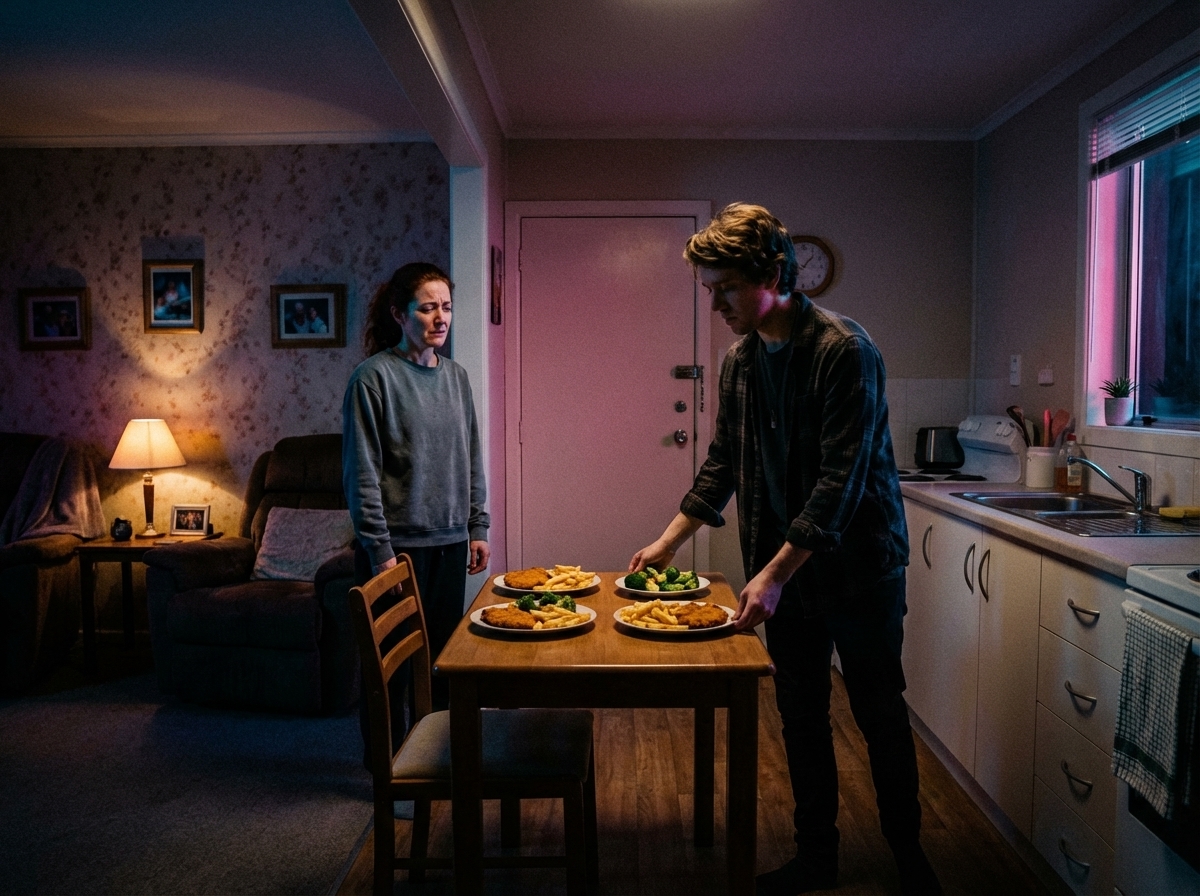
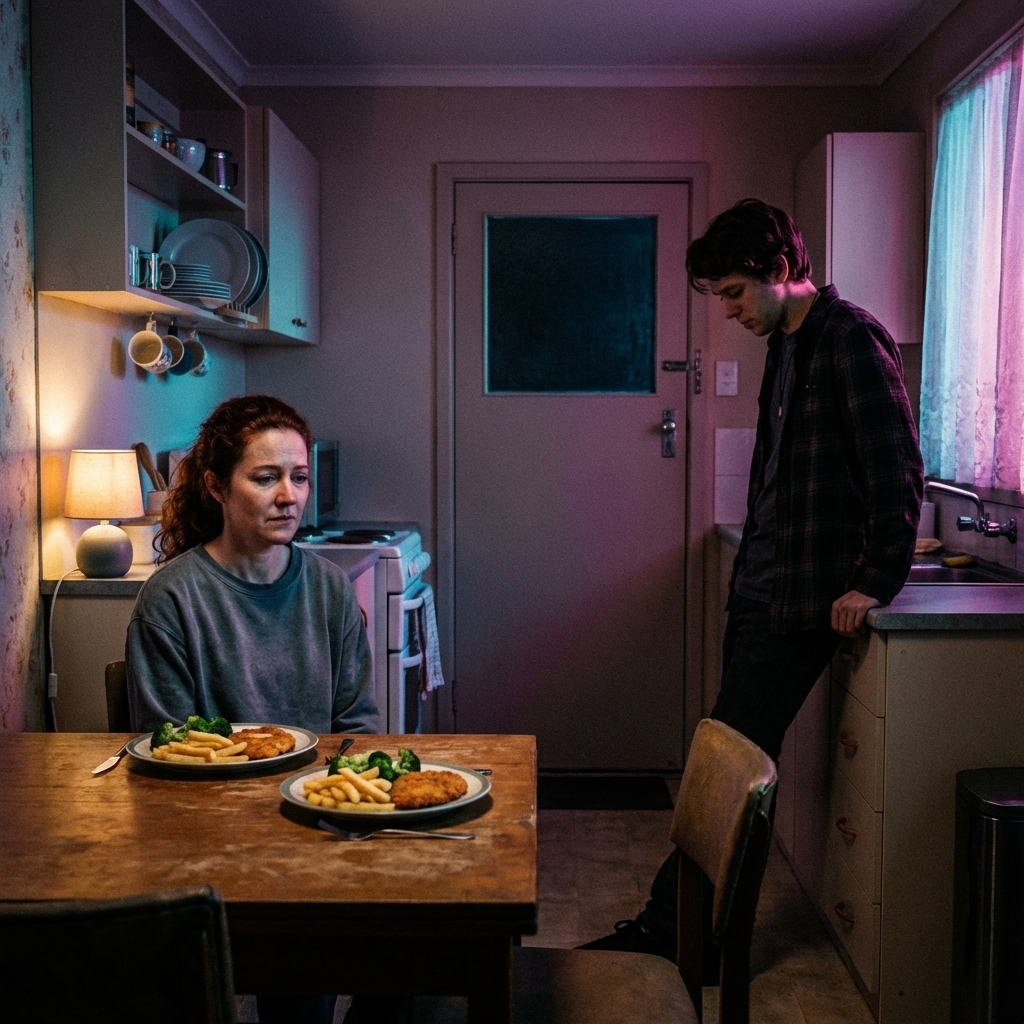
How much does normal cost? If you're Kate Gibbons — forty-one, single mother, Glenorchy, Tasmania — the answer is approximately twenty-three dollars. That's what her nineteen-year-old son Joel spends on a Woolworths bag of chicken schnitzel, sea salt chips, fresh broccoli, and a tub of vanilla ice cream on a Tuesday evening when neither of them can afford it and both of them need it more than they can say. Twenty-three dollars. In a household where the electricity bill is overdue and the credit card is at its limit and thirty-seven dollars is supposed to stretch across seven days of meals. Twenty-three dollars that Joel doesn't have, spent on food they don't buy, prepared in a kitchen neither of them can comfortably enter since this morning, when a government document with a name Kate had hidden for nineteen years landed between them and detonated. That's the moment. Not the revelation. Not the lie. The meal that follows.
Welcome to the Clivilius Storiverse Podcast. I'm Nathan. And this is where I pull back the curtain on individual moments within the Storiverse — the people, the decisions, the collisions between ordinary lives and extraordinary circumstances. Each episode, I take one moment, and I unpack what's really going on beneath the surface. The psychology. The relationships. The things people do when the rules they've lived by suddenly stop applying.
Today: a mother, a son, and the economics of love when you can't afford the truth.
THE ECONOMICS OF CARE.
Here's what I want to talk about. Not the lie — not yet. Not the name on the birth certificate or the nineteen years of silence or the way Kate's world collapsed in a kitchen this morning. What I want to talk about is what happens when a nineteen-year-old boy walks into a Woolworths after the worst day of his life and buys chicken schnitzel.
Because that purchase tells you everything about the Gibbons household that a biography never could.
Kate and Joel live in a red-brick unit in Glenorchy, walking distance from Tolosa Park. Kate left school early. Joel left school at seventeen to drive a courier van because the household needed his wages more than he needed an education. They divide his pay into piles at the kitchen table: rent, medical bills, the electricity company's final notice, the credit card minimum. There is no pile labelled "surplus." There is never surplus.
In this household, food is not just sustenance. It's a moral calculation. Every purchase is weighed against every bill. Vegetables come from the reduced section — limp, yellowing, but edible. Pre-made meals don't happen. Ice cream doesn't happen. The good chips with herbs printed on the packet absolutely do not happen.
And then Joel spends twenty-three dollars on all of it. At once. On a Tuesday.
This is what love looks like when you're broke. It doesn't look like flowers or jewellery or grand gestures. It looks like a financial decision that makes no practical sense, made by a person who has nothing else to offer. Joel can't fix what happened this morning. He can't un-learn the name on the birth certificate. He can't make his mother's lie disappear or his own anger dissolve. But he can buy chicken schnitzel. The good ones. And he can bring them home and cook them and put them on a plate and say "just eat it, okay?"
That's not generosity. That's desperation dressed as dinner. And Kate knows it. She catalogues every item Joel unpacks with the precision of someone who has spent two decades translating love into arithmetic. She knows to the dollar what this meal costs, what it displaces, what bills will go unpaid because her son needed to feel like he could fix something in a world that proved spectacularly unfixable this morning.
And she eats it. Because refusing would break him worse than the lie already has.
THE KITCHEN THAT CHANGED.
There's something in Kate's account that I think is easy to miss but essential to understanding this evening. She can't enter the kitchen.
Not physically — the kitchen is ten steps away. But this morning, under harsh fluorescent light, that kitchen became the place where nineteen years of carefully maintained fiction disintegrated. The birth certificate sat on the table. Joel stood in the doorway. The air itself changed density, Kate says, as though the room had been pressurised by the weight of what was finally being said.
And now, hours later, she still can't cross that threshold. She sits on the sofa while her exhausted son cooks dinner in the room where she destroyed his trust this morning. She knows mothers should help. She knows she should get up. She can hear every sound of his movements — the cupboard with the loose hinge, the oven dial that needs jiggling past 180 degrees — and she is frozen by the understanding that the kitchen isn't a kitchen anymore. It's a crime scene. The site where she committed the offence of telling the truth after two decades of choosing not to.
This is something that doesn't get talked about enough: how spaces change after revelations happen in them. The room itself becomes contaminated. Not with anything visible — the table's been wiped, the document's been put away — but with the memory of what was said there. And Kate is living in a house where the most important room has become the one she can't bear to stand in.
WHAT JOEL'S EYES TELL HER.
When Joel fills the doorway of the lounge room, Kate has to suppress every maternal instinct she has. The urge to go to him. To smooth his hair. To gather him close the way she did when he was small and the world was simple and she was the person who made everything safe.
She can't do that anymore. Not because Joel won't let her — he might — but because she understands, with a clarity that guts her, that she has forfeited the right to easy physical comfort. Trust, once fractured, makes touch complicated. Every embrace now carries the question: is this genuine, or is this another performance?
And what she sees in Joel's face confirms the damage. He looked different this morning — shocked, confused, but underneath it all, there was still a foundational belief that his mother wouldn't deliberately hurt him. That look is gone. Replaced by something guarded. Something wounded. Something that Kate recognises with horror as the expression of a person who has just learned that love and betrayal can wear the same face.
She taught him that. That's what she keeps coming back to. She showed her son — through nineteen years of example — that the people you trust most can carry lies for decades and call it protection. And the lesson landed. It landed in the way his eyes have changed, in the guard he's put up, in the new distance between them that chicken schnitzel cannot cross.
THE FIRST SWEAR WORD.
There's a moment after Kate tries to apologise — tries to pour out the explanation she's been rehearsing all day — when Joel says something he's never said before.
"I'm so fucking tired."
He's never sworn in her presence. Not once in nineteen years. And that single word — the profanity itself — does more to describe the state of their relationship than any amount of careful dialogue could manage.
Because here's the thing: Joel didn't swear out of anger. He swore out of exhaustion. There's a crucial difference. Anger is directed. Anger has a target and an energy and a desire to inflict damage. Exhaustion is formless. It's the sound a person makes when they've been carrying something all day that they didn't ask to carry, and they can't hold it anymore, and the muscles just give out.
Joel has spent the entire day delivering parcels. Every single delivery, every single moment, thinking about the name on the birth certificate. About the father he was told was dead. About the mother who lied. And by six o'clock, the weight of it has compressed everything he knows about politeness and respect and the careful rules of engagement between a son and his mother into a single, honest word.
And Kate — this is the part that gets me — feels relief. Not at the swearing. At the honesty. Because the profanity is the first completely unedited thing Joel has said to her since this morning. Everything else has been careful. Neutral. Controlled. "Fine. Long." "I brought dinner." "It's chicken schnitzel and chips, Mum. It's not too much." All of it measured, managed, kept within the bounds of politeness that was their normal currency.
The swear word breaks through all of that. It's raw. It's ugly. It's real. And for one second, Kate isn't talking to a son performing composure. She's talking to a person who has been hurt and is saying so.
He apologises immediately, of course. And that apology hurts worse than the profanity.
TWO SCOOPS.
After the plates are cleared, Joel reappears with a tub of vanilla ice cream from the freezer. Kate's favourite. They haven't bought ice cream in months.
"Like normal people," Joel says. "Like we used to."
And this phrase — "like we used to" — is doing something enormous in just four words. Because what Joel is asking for isn't ice cream. He's asking whether the life they had before this morning is still accessible. Whether they can sit in front of the television and eat something cold and sweet and ordinary and pretend, even for ten minutes, that the ground beneath them hasn't shifted.
He scoops conservative portions. Two small scoops each. Half the tub saved for later. Because even in this gesture toward normality, they are who they are. They stretch. They ration. They make do. The economics of scarcity don't pause for emotional crises. You can shatter a nineteen-year relationship with a single document and you still save half the ice cream.
And that detail — the rationing — is what makes this moment so unbearably human. This isn't a family with resources. There's no therapist waiting in the wings, no extended family to absorb the shock, no safety net of any kind. It's two people in a small house with thin walls and mismatched plates and an electricity bill they can't pay, trying to hold each other together with vanilla ice cream served in the small bowls because the small bowls are all they have.
THE PROMISE THAT ISN'T ONE.
Kate tells Joel she loves him. She says it staring into her ice cream bowl because she can't meet his eyes. "You're the best thing I ever accomplished. The only thing I got right."
And then she asks for something she has no right to ask for: "Promise you won't leave."
There's a particular cruelty in needing reassurance from the person you've hurt. It reverses the moral flow — the injured party is now being asked to comfort the person who injured them. Kate knows this. She hears how small and childlike the request sounds and she's ashamed of it. But she can't stop herself, because the fear of losing Joel is the same fear that made her lie in the first place, and fear doesn't learn from its own mistakes.
Joel says "I promise." And they both know — Kate says this explicitly in her account — that neither of them feels certain of its truth.
But he says it anyway.
Because that's what love does when it's out of options. It makes promises it isn't sure it can keep, because the alternative — the silence, the absence of any commitment at all — is worse. Joel can't guarantee he won't leave. He can't guarantee the damage is survivable. But he can say the words his mother needs to hear, the same way he can buy chicken schnitzel and scoop ice cream and wash the dishes and pretend that routine can substitute for resolution.
Later, Kate lies in bed fully clothed. Through thin walls, she hears the television still murmuring. Joel is still awake. Still sitting in the lounge. Still processing.
And Kate weeps. Silently, because the walls are thin and some things still need to be hidden, even now, even after the biggest hiding has been undone.
Tomorrow the bills will still need paying. The fridge will still be mostly empty. Nothing will be repaired just because they shared a meal. But tonight, in a modest unit in Glenorchy, a mother and her son sat together and tried. That's all they had. Twenty-three dollars and a promise and the stubborn, inadequate, irreplaceable fact of each other.
That's the price of normal, when nothing is normal anymore.
AND FINALLY.
Next time on the Clivilius Storiverse Podcast, we step into a different life, a different moment, a different corner of this world. That's how this works — every episode is a window into a single moment and the ripples it sends through the lives around it.
I'm Nathan. Thanks for listening. And if you've ever bought something you couldn't afford because the person you love needed to believe the world was still whole — Kate would understand exactly.