Episode 012: The Thursday Ministry
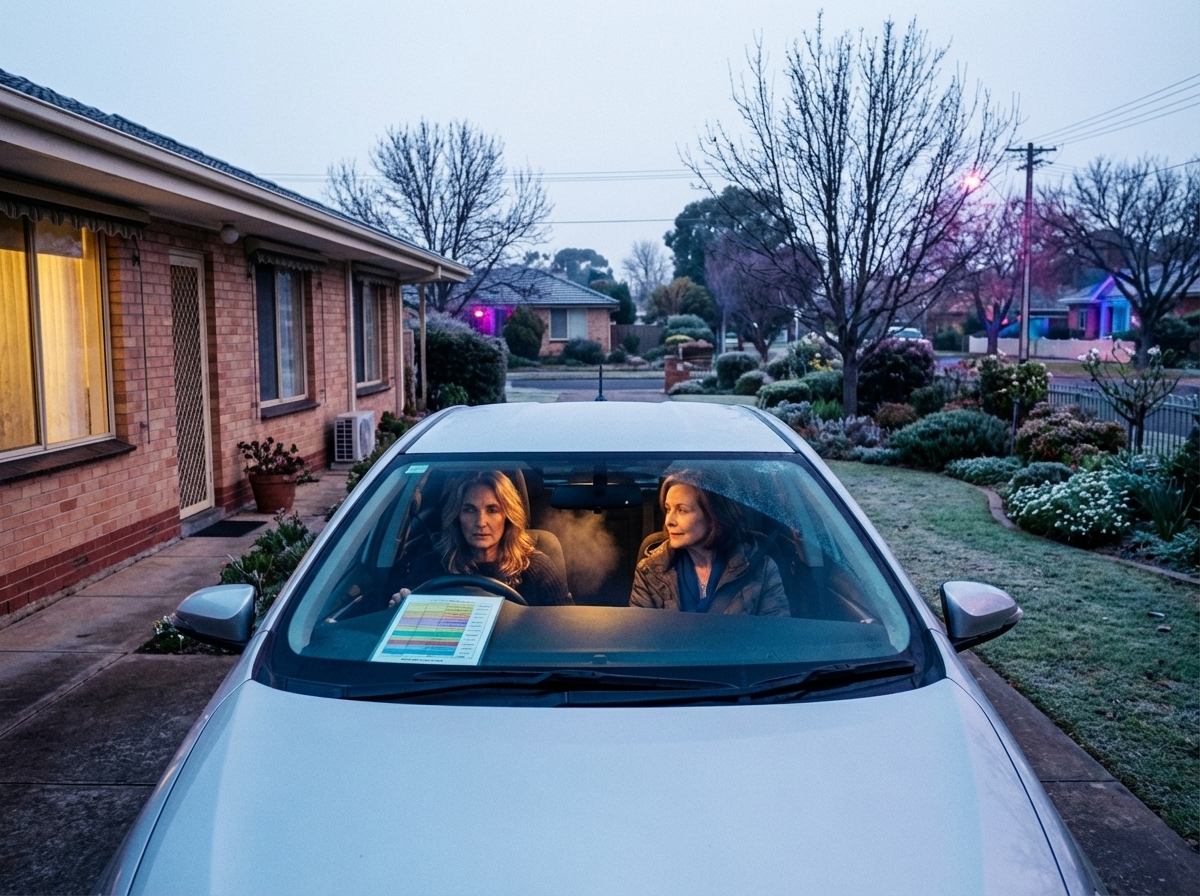
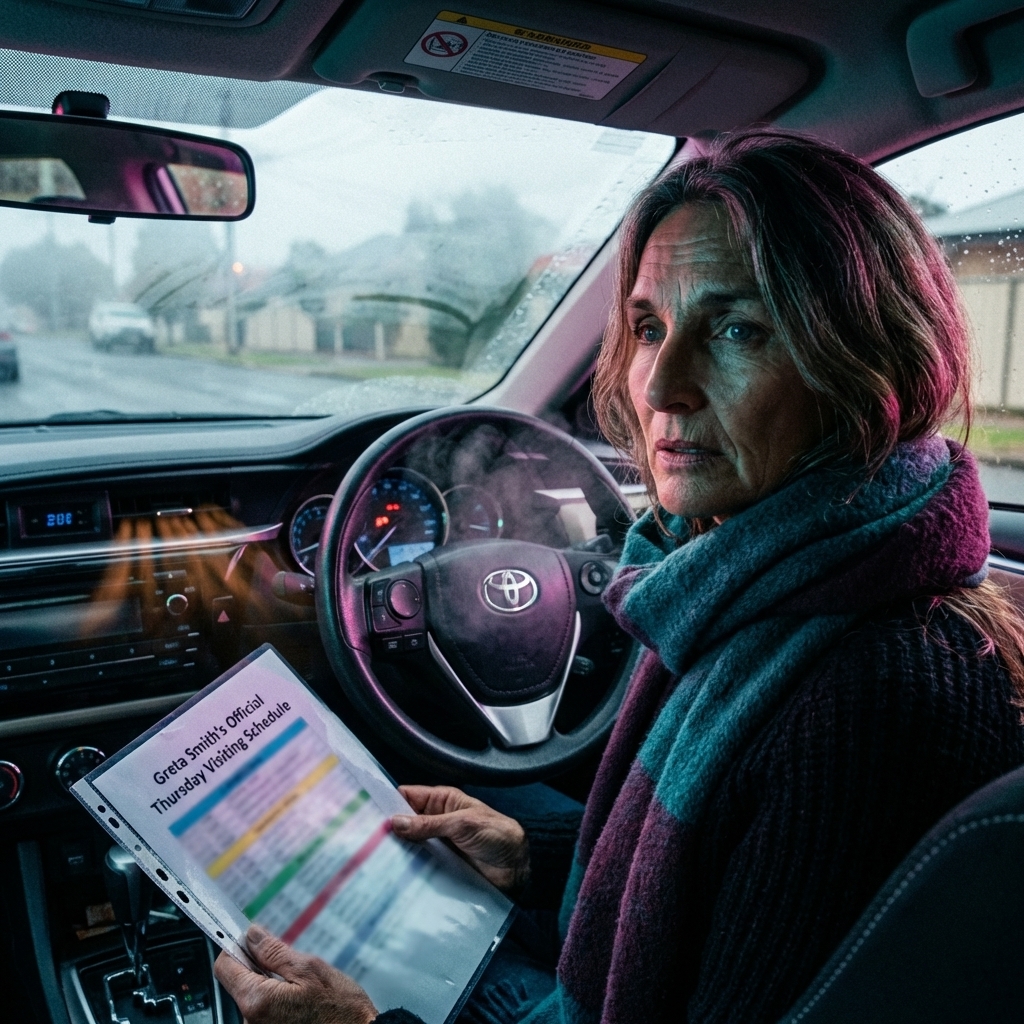
A woman is sitting in an ageing Toyota Corolla in an Adelaide suburb at half past nine on a Thursday morning in July. The engine is running. The heater is trying. Her breath is fogging the windscreen in pale, anxious plumes. In her handbag — brown leather, fraying at the corners, stubborn clasp — there is a laminated A4 sheet. Typed the night before. Double-checked. Cross-referenced. Laminated. It is titled "Greta Smith's Official Thursday Visiting Schedule." It is colour-coded. That's the moment.
Welcome to the Clivilius Storiverse Podcast. I'm Nathan. And this is where I pull back the curtain on individual moments within the Storiverse — the people, the decisions, the collisions between ordinary lives and extraordinary circumstances. Each episode, I take one moment, and I unpack what's really going on beneath the surface. The psychology. The relationships. The things people do when the rules they've lived by suddenly stop applying.
Today: a laminated list, an ageing Corolla, and a woman who can't control the world but can absolutely control Thursday.
FAITHFUL, IF AGEING.
Let me start with the car. Because the car is Greta before Greta says a word about herself.
The Corolla gives its usual soft grumble when she turns the key. The engine shakes off the night's chill with more enthusiasm than she can summon. The dashboard lights up in pale green and amber, blinking into wakefulness "like someone rising reluctantly from sleep." The heater, pre-warmed for ten full minutes while Greta stood at the kitchen window with her second cup of tea, delivers what she describes as "air with intentions." Warmth-adjacent. Not quite there.
She calls the car "faithful, if ageing. A bit like me."
And that throwaway comparison does more work than Greta probably intended. Because faithful-if-ageing is the operating principle of everything in her life. The handbag with the fraying stitching that's been through school drop-offs and emergency dentist visits. The scarf she adjusts at her neck — teal and plum, not fashion but armour. The Corolla itself, seven faithful winters old, groaning a little more than it used to but still turning up, still starting on the second try, still carrying her where she needs to go.
There's something in this that I think a lot of people will recognise without anyone needing to name it. The relationship you develop with the objects that carry you through your routines. The car that starts on the second try. The bag with the stubborn clasp. The coat that's been resoled twice. You don't love these things because they're beautiful or efficient. You love them because they're still here, still trying, still performing the function they were built for despite every reason to have given up. And if you're honest with yourself, you know you're describing your own situation as much as theirs.
Greta hasn't slept well. There's a worry humming underneath the morning — something about her daughter-in-law Claire's clipped tone on the phone the night before, something about her son Paul's silence. She describes it as the kind of worry that doesn't shout but hums. Quiet and persistent, like a fridge in another room. Always there. Always just noticeable enough to wear you down.
The Corolla hums too. They make a pair.
ARMOUR MADE OF PLASTIC.
At the first red light, Greta reaches into her handbag and pulls out the laminated sheet.
It was typed the night before, after the last stitch on a dress she's remaking for a girl named Shayna. She double-checked every detail. Cross-referenced times. And laminated it. Because that's what Greta does. That's how Greta holds the line between functioning and falling apart.
I want to talk about what laminating means. Not practically — everyone knows what a laminator does. I mean psychologically. What drives a person to take a document that will be used once, for a few hours on a single Thursday, and seal it in plastic?
The answer isn't efficiency. The answer is fear.
A laminated schedule can't be smudged by rain. Can't be crumpled. Can't be rendered illegible by the chaos of a morning that doesn't go to plan. It is a small, rectangular fortress of certainty in a world that refuses to be certain about anything. Greta can't make her son call. She can't make Claire explain what's wrong. She can't switch off the hum. But she can laminate Thursday. She can type the names and the times and the notes and seal them behind plastic, and for the duration of that schedule, the world has edges. The world has order. The world behaves.
I think almost everyone has a version of this, even if they've never touched a laminator. The midnight cleaning when you can't sleep. The meal prep that takes three hours because if you can get the containers right, the week itself might cooperate. The spreadsheet that nobody asked for. The reorganised bookshelf. It's not about the task. It's about the illusion of control in a life that's refusing to provide any.
Greta frames it as principle: "Organisation isn't obsession — it's love made practical." And she's right. But she's also describing the particular shape that love takes when the person doing the loving is terrified that love alone isn't enough. That without the schedule, without the structure, the caring itself might dissolve into something shapeless and unreliable. That she might forget someone. Miss something. Let a person down. And in Greta's world, letting a person down is the one failure she cannot laminate her way past.
TWO WAYS OF WALKING INTO A ROOM.
Evelyn Baker climbs into the Corolla at 9:49 wearing a pale blue cardigan that wouldn't keep a sparrow warm. Greta tells her she's going to catch her death. Evelyn says the car heater is better than the one in her lounge room. They bicker about coats and tissues and the expired prescription in the glovebox — half-squashed peppermints rolling out like tiny deserters — and every word of it is the verbal shorthand of two women who've known each other for years, whose love is expressed entirely in dry observations and knowing smirks.
Evelyn reads the laminated schedule aloud in her best announcer voice and laughs so hard she fogs up the window. "You really are a marvel of organisation, Greta." And Greta, hands on the wheel, eyes on the road, says: "I'm realistic."
But the reason Evelyn matters in this account — the reason Greta keeps returning to her — isn't the comedy. It's the contrast.
Greta and Evelyn carry the same calling. They visit the same sisters. They perform the same ministry. And yet Evelyn moves through it with what Greta describes as something close to instinct — an unhurried presence, a warmth that seems effortless, a way of simply being in a room that makes people want to stay near her. She's the person people linger beside after church, drawn without quite knowing why. Not because she says the right thing. Because she is the right thing. A presence that doesn't demand attention but anchors it.
Greta marks checkboxes. Tracks time. Rehearses conversations in the car. Her warmth is, in her own words, "constructed — practised through care and repetition."
Both have value. She tells herself that. Both have value.
But sitting at a red light, watching the winter sun fall across Evelyn's calm face, Greta allows herself to feel something she rarely names. Not jealousy — she's clear about that. Something quieter. Something closer to grief for the version of herself who might have been effortless, if the world had built her differently. If the worry didn't hum. If the fridge in the other room would just, for one morning, switch itself off.
This is something almost never spoken about honestly: the experience of admiring someone's natural gift for the thing you have to work at. The colleague who walks into presentations without notes. The parent who plays with their children without first calculating whether there's time. The friend who just is warm, while you have to remember to be. It's not resentment. It's the quiet ache of knowing that your version of the same quality — equally real, equally sincere — will always feel like something you built rather than something you are.
Greta builds. Evelyn arrives. And Thursday needs them both.
NOT READY, BUT BEGINNING.
They pull up outside Sister Trenerry's modest brick unit. Faded bricks. A crocheted cushion visible through the window. A garden gnome with a chip on its nose keeping silent company beside the cracked concrete step. The front garden bears the signs of determined care slowed by aching joints — rose bushes pruned by hands that remember the angles but no longer have the strength for subtlety.
Before they've fully stopped, the lace curtain twitches. A flutter of gauze and motion behind glass. Gwen has been watching. Listening for tyres on gravel. Listening for voices outside that mean she hasn't been forgotten.
Evelyn smoothes her skirt. "Ready?"
And Greta — who has typed the schedule, laminated the schedule, pre-warmed the car for ten minutes, calculated the route, rehearsed the conversation, already begun recalculating the afternoon (dinner needs sorting, lentils probably, Noah's cholesterol is nudging upward, and while she can't hold the world together on prayer and chickpeas alone she can at least ensure they're not facing cardiovascular disaster on top of everything else) —
Greta says: "Not really. But let's begin anyway."
Not ready, but beginning anyway. That's not just Greta at a doorstep. That's Greta's entire architecture. The laminated list. The faithful Corolla. The scarf adjusted one more time. The whole assembled apparatus of a woman who has never once in her life felt ready for the thing she's about to do and has never once let that stop her from doing it.
Because the ministry doesn't wait for confidence. The lonely woman behind the twitching curtain doesn't care whether Greta felt ready when she knocked. She cares that Greta knocked. That somebody showed up. That the sound of tyres on gravel meant she hadn't been forgotten — and it doesn't matter whether the person on the other side of the door arrived through effortless grace or through a colour-coded schedule laminated at eleven o'clock the night before.
The showing up is the thing. The rest is just how you get yourself to the door.
The world is messy. Paul isn't calling. Claire's tone was wrong. The Corolla's heater delivers air with intentions. The worry hums like a fridge in another room. And Greta Smith, who cannot control any of it, squares her shoulders, looks at a weathered red door, and begins.
That's what love looks like when you're the kind of person who has to build it rather than simply feel it. It looks like a laminated Thursday. It looks like a car that starts on the second try. It looks like saying "not really" when someone asks if you're ready, and getting out of the car anyway.
AND FINALLY.
Next time on the Clivilius Storiverse Podcast, we step into a different life, a different moment, a different corner of this world. That's how this works — every episode is a window into a single moment and the ripples it sends through the lives around it.
I'm Nathan. Thanks for listening. And if you've ever made a list not because you needed one, but because making it was the only way you knew how to hold yourself together — Greta would understand. She'd probably laminate it for you.