Episode 015: The Letter at Dawn
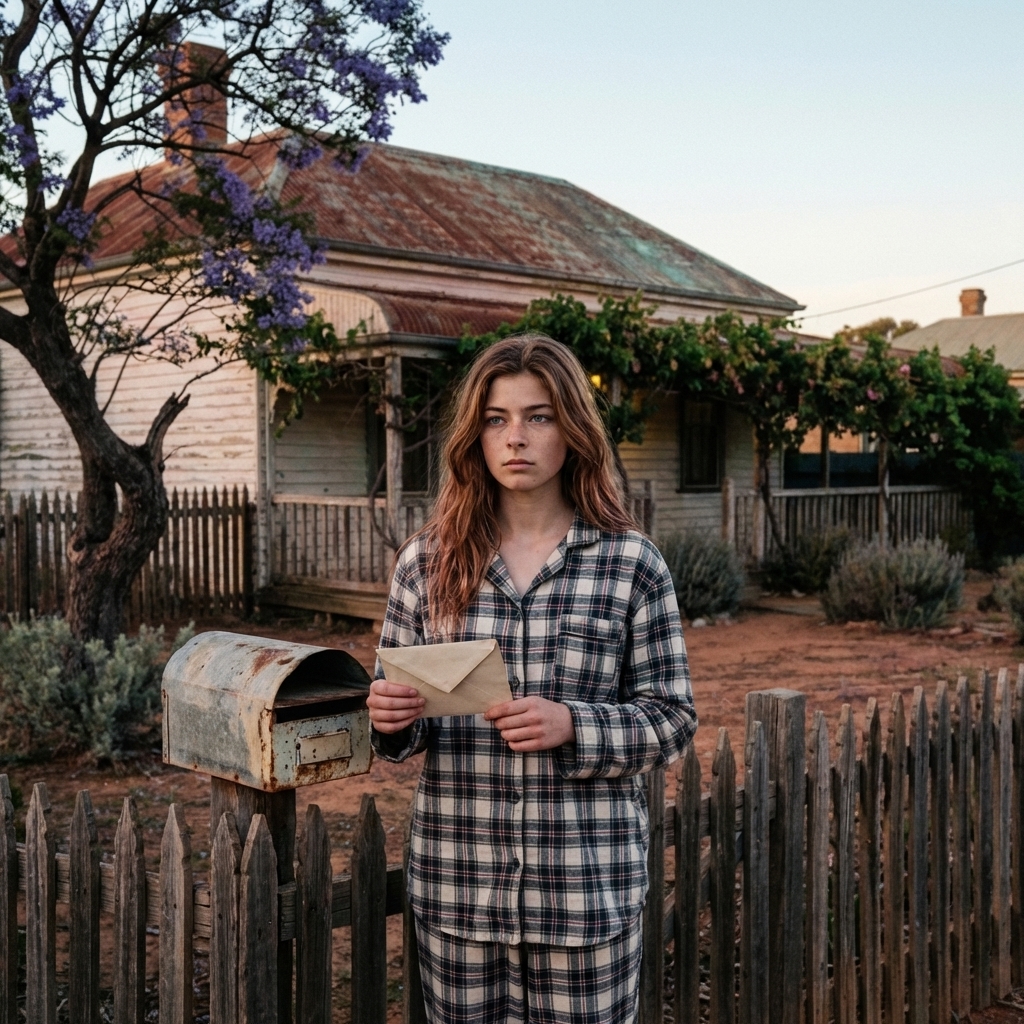
A sixteen-year-old girl is standing barefoot at the front gate of her family's house in Broken Hill. It's not yet fully light. The red dust across the wide street lies undisturbed. The air carries the coolness of night's retreat and the faint scent of eucalyptus from the trees at the edge of the yard. The letterbox — a weathered, lopsided tin relic that lost its paint years ago — is sitting ajar. It's far too early for the postman. Something pale protrudes from the slot. Inside is an envelope. No stamp. No return address. Just her name, scrawled in hurried, uneven blue ink, slightly smudged, as if the writer's hand had trembled. She takes it into the kitchen. She reads it. And by the time her thirteen-year-old sister wanders in for breakfast, the letter is hidden in a schoolbag and the distance between two sisters who have never had distance before has already begun. That's the moment.
Welcome to the Clivilius Storiverse Podcast. I'm Nathan. And this is where I pull back the curtain on individual moments within the Storiverse — the people, the decisions, the collisions between ordinary lives and extraordinary circumstances. Each episode, I take one moment, and I unpack what's really going on beneath the surface. The psychology. The relationships. The things people do when the rules they've lived by suddenly stop applying.
Today: a letter, a kitchen table, and the weight of the first secret you keep from someone you love.
THE FIRST SECRET.
I want to talk about the first time you lie to someone you've never lied to before. Not the small social lies — "I'm fine," "I love the haircut," "no, I wasn't asleep." The real first lie. The one where you're looking at a person who trusts you completely, who has no framework for the possibility that you might withhold something important, and you make the decision — consciously, deliberately — to keep them in the dark.
Violet Dallow is sixteen. She lives in Broken Hill with her parents, her younger sister Jasmine, and the particular brand of restless curiosity that comes from growing up in a place where the horizon is visible in every direction and the landscape itself seems to be daring you to go further. She loves history, unsolved mysteries, forgotten stories. She's the kind of girl who reads newspaper clippings about disappearances from decades ago and feels the pull of them — the unanswered questions, the silences that accumulate around the missing.
Jasmine is thirteen. She still collects stickers in a scrapbook. Still plaits her hair in front of the mirror. Still calls out for their mum when nightmares claw too deep. She's the younger sister in the purest sense — following where Violet leads, trusting where Violet trusts, occupying a version of the world that's still mostly intact.
And on this morning in September 1988, standing in a kitchen in Broken Hill with an anonymous letter in her hands and the sound of Jasmine's footsteps approaching down the hallway, Violet makes the first decision that will create a space between them that Jasmine can't see and can't cross.
She hides the letter.
WHAT THE ENVELOPE CARRIES.
The letter itself is extraordinary — frantic handwriting, no signature, warnings about disappearances and abandoned mines and dangers in Silverton. It references a missing woman named Sally Harlow, names places Violet has known since childhood but reframes them as something sinister: the park where the Girl Guides camp, the mine shaft her father warned her never to approach.
But the letter isn't what this episode is about. The letter is the catalyst. What this episode is about is the kitchen that exists after the letter has been read and before the sister walks in.
Because in that gap — those few minutes between reading the last line and hearing Jasmine's footsteps — something shifts in Violet's internal architecture. She's no longer simply a girl who's read something alarming. She's a girl who's deciding, in real time, what to do with the alarm. And the first thing she decides is that Jasmine can't know.
Not because the letter instructs her to tell no one — though it does. Because of something more instinctive than instruction. The image of Jasmine's wide, uncertain eyes stops her. The recognition that her sister is thirteen and still lives in a world where the worst things that can happen are nightmares that end when you call out. The understanding — sudden, heavy, adult in a way Violet wasn't yesterday — that knowing certain things changes you, and she doesn't want Jasmine changed. Not yet. Not by this.
This is the moment that every older sibling, every parent, every person who has ever loved someone younger or more vulnerable eventually faces. The moment when you realise that protection and honesty are not the same thing, and that choosing protection means choosing to carry something alone.
THE KITCHEN BETWEEN THEM.
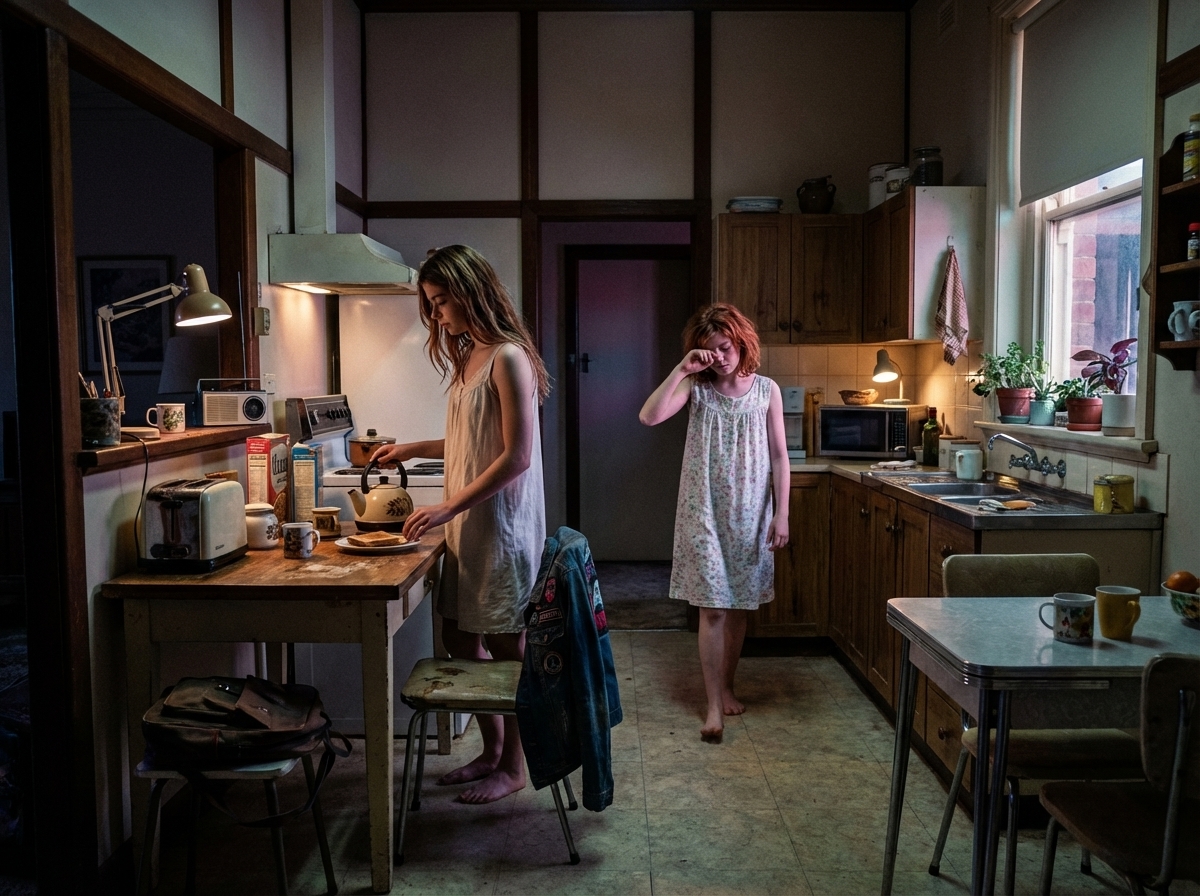
Jasmine wanders in. Tousled hair. Nightdress trailing. Rubbing her eyes with the back of her hand. "Morning, Vi. What are you doing up so early? You look like you've seen a ghost."
The accuracy of that lands harder than Jasmine can know. And Violet has to perform — in the space of a single heartbeat — a transformation that most adults struggle with: she has to become someone who has something to hide while appearing to be someone who doesn't.
"Just sorting through the mail," she says. Angling her body so the table — and the envelope — is out of Jasmine's sightline. Her voice coming out steadier than she feels.
"Is everything okay? You're acting weird."
And there it is. The first probe. The first test of the lie. Jasmine doesn't know she's testing anything. She's just being a sister — reading the room the way sisters do, with the casualness of someone who's been watching you since birth. She can tell something is off. She can't tell what.
Everyone who's ever held a secret in the presence of someone who knows them well will recognise this moment. The particular discomfort of being seen by someone who's looking at the real you while you're performing a version that isn't quite real. The awareness that the person across the table has better radar than you'd like, and that every second you maintain the performance increases the distance between the person they're talking to and the person you actually are.
Violet says: "Yeah, just some things I need to figure out. Don't worry about it. How about I make us some breakfast?"
And the kitchen — which was, sixty seconds ago, the same kitchen it's always been — becomes a divided space. Violet on one side with the letter. Jasmine on the other without it. Toast in the middle, doing its best to pretend everything is normal.
TOAST AND THE PERFORMANCE OF ORDINARY.
Violet makes breakfast. Clatters bread into the toaster. Fills the kettle. Sets cups down on the scarred wooden bench. The ordinary sounds fill the silence, but they don't fill it enough — the letter is burning in her thoughts, and every domestic action feels like a performance rather than a routine.
I think this is one of the most recognisable experiences of carrying a secret: the way ordinary tasks become theatre. You're making toast, but you're not making toast — you're making toast so that the person watching you will believe that toast is what you're thinking about. The kettle is a prop. The cups are stage dressing. The entire production of breakfast is a set designed to communicate normality while the thing that is actually happening — the recalibration of every relationship in the room — proceeds silently behind it.
Jasmine eats slowly. Picks at the edges of her toast. Watches her sister with the sharpened curiosity of a younger sibling who can sense, with the unfailing instinct of someone who's spent thirteen years studying this particular person, that something isn't being said.
"So what's this big thing you've got to figure out?"
Violet pulls an excuse from memory — schoolwork, a group project, Mr Clarke's history assignment. It has some truth to it, which helps. But it twists in her stomach. Because this is the second lie. The first was omission — hiding the letter. The second is fabrication — inventing a reason for behaviour that the truth would explain perfectly but can't be shared.
"You're on holidays though. Who does homework on holidays?"
And Violet turns away. Because her sister is right, and the lie is thin, and the face she's wearing can't hold up to direct scrutiny.
THE RUFFLED HAIR.
Violet changes out of her nightdress — Jasmine catches her at the door, still in her pink flowers and frayed lace, and the sisters share a genuine laugh. For ten seconds the morning is ordinary again. Two sisters teasing over breakfast. Nothing lurking.
And then Violet picks up her bag — the one with the letter inside it, pressed between a dog-eared notebook and a bundle of pens — and heads for the door.
"Don't be gone too long, alright?"
Violet hesitates. And what happens next is the detail I keep returning to, the one that holds the emotional weight of this entire morning.
She crouches slightly. Ruffles Jasmine's hair. Holds the gesture a fraction longer than usual.
"You'll be fine," she says softly. "Promise."
Jasmine leans into the touch. A faint, contented smile.
That ruffled hair. That extra fraction of a second. That's where the whole morning lives.
Because Violet knows — in the way that you know things at sixteen when the world has just become larger and more dangerous than it was yesterday — that she is crossing a line she can't uncross. Not the line of the mystery or the investigation or whatever she's about to go and do with her friends. The line between the sister who shared everything and the sister who has started choosing what to share. The line between Jasmine's world, where the worst things end when you call out, and Violet's world, where an anonymous letter in a letterbox means the worst things might not end at all.
The ruffled hair is an apology Jasmine can't hear. It's a goodbye to a version of their relationship that existed before this morning and that Violet already knows won't exist in the same way after it. It's the gesture of someone who is doing the thing that older siblings do — absorbing the danger so the younger one doesn't have to — and who is discovering, in real time, that protection feels nothing like the noble, selfless act she imagined it would be. It feels like loneliness. It feels like standing in a kitchen with your favourite person in the world and being, for the first time, unreachable.
THE SCREEN DOOR.
The screen door claps shut behind Violet. Jasmine is left with her toast. The kitchen returns to the sounds it makes when only one person is in it — the tick of the clock, the hum of the fridge, the eucalyptus moving against the fence outside.
Every family has a version of this morning. Not the anonymous letter — that's specific to Violet's life in Broken Hill in 1988. But the shape of it. The morning where one person at the table knows something the other doesn't, and the silence between them becomes a new kind of silence — not comfortable, not hostile, but loaded. The morning where breakfast is both real and performance. The morning where a gesture of affection carries a weight the recipient can't feel because they don't know what it's compensating for.
The first time you protect someone by lying to them, you discover something uncomfortable about yourself: you're good at it. The steadied voice. The angled body. The schoolwork excuse. The toast. You can do this. And the fact that you can do this — that the lie comes smoothly, that the performance holds, that the person you love most doesn't catch it — doesn't feel like relief. It feels like proof that something has changed in you that can't change back.
Violet walks out the screen door carrying a letter that's going to pull her further into something she doesn't fully understand. But the thing she's already lost — the thing she lost the moment she decided to hide instead of share — is the version of herself that existed before she knew how to lie to her sister's face.
Jasmine finishes her toast. The kitchen is quiet. The sticker scrapbook is somewhere in her room, the nightmares still end when she calls out, and the morning — for her — is just a morning.
The distance between them is nine steps down a hallway. And it has never been wider.
AND FINALLY.
Next time on the Clivilius Storiverse Podcast, we step into a different life, a different moment, a different corner of this world. That's how this works — every episode is a window into a single moment and the ripples it sends through the lives around it.
I'm Nathan. Thanks for listening. And if you've ever ruffled someone's hair a little longer than usual because you were carrying something you couldn't tell them — you already know what Violet knew. That the hardest secrets aren't the ones other people keep from you. They're the ones you keep from the people you'd give anything to share them with.